
EAFLOW · SOLUTIONS · CROSS-INDUSTRY SOLUTION · AREA 03

Service Operations Governance.
Govern operation and SLAs
without replacing your current tools.

Connect operation, architecture and knowledge on the Operational Graph: tickets, processes, applications, vendors, contracts, SLAs, risks, controls, documents, decisions and audit. Built on Operational Graph. Operational decisions are governed with SLA as input — not as a post-mortem output. Cross-industry solution in Area 03 — operations and vendors. Assisted implementation.

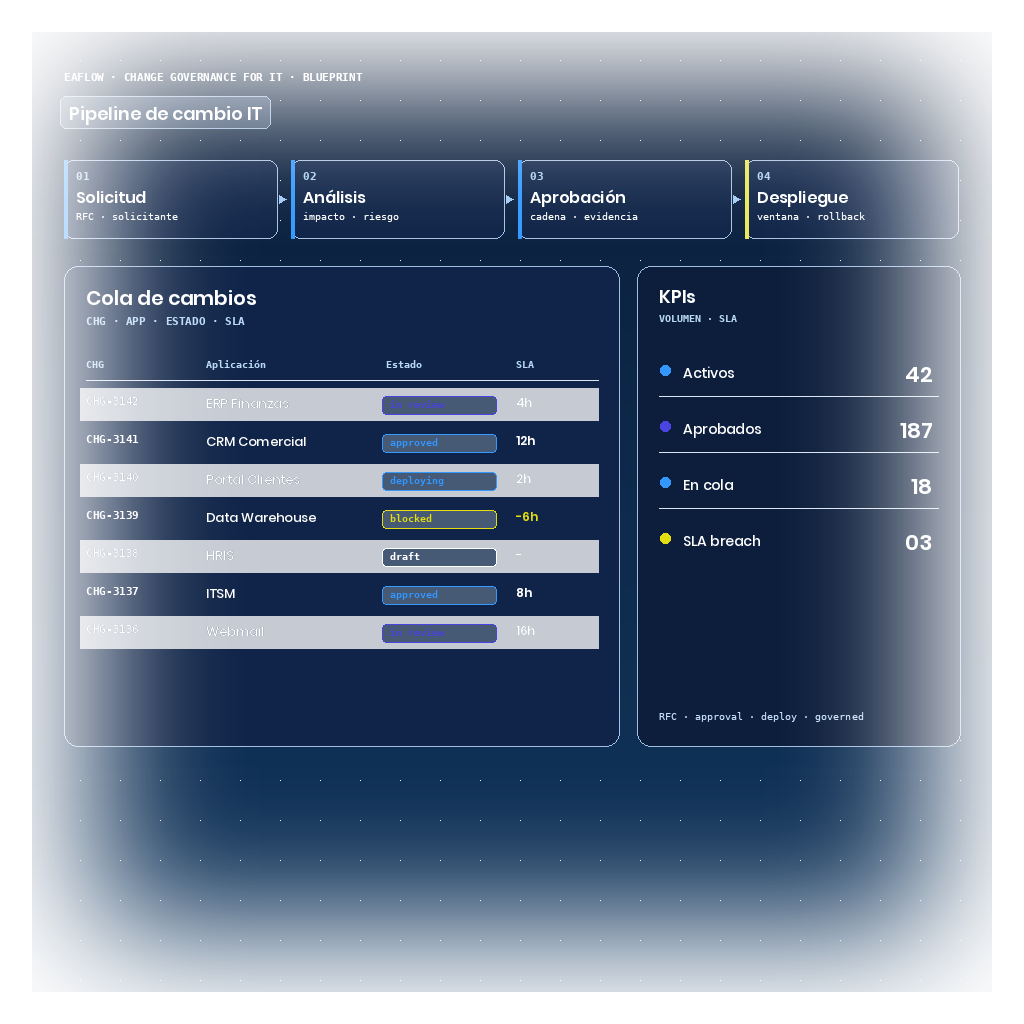
EAFlow blueprint with an IT change pipeline: change queue with CHG, affected application, state (draft / in review / approved / deploying / blocked) and SLA — one blocked change highlighted in amber with SLA in breach — and a side panel with volume and SLA KPIs.
Category
IT change governance and service operations
Users
IT change managers, CAB, service operations, IT audit
Output
Governed change pipeline, approval evidence, control traceability
Implementation
Packaged app with assisted implementation
Does not replace
Your current ITSM or change workflow; adds evidence and traceability layer on the graph

01 · What it is

Change governance is usually three workflows in a trench coat.

In most enterprises, governing a change means reconstructing the picture every time. The change request lives in one tool, the risk assessment in another, the control evaluation in a third, the application impact in a fourth, the ownership somewhere else entirely. Approvers piece the picture together at the gate. Auditors piece it together again, months later. The reconstruction is the work.

Change Governance for IT connects these into a single workflow on the Operational Graph. The change carries its risk assessment, its control evaluation, its application impact and its ownership as part of the graph — not as separate references stapled on at the end. Governance becomes one traceable flow from request to closure, evidenced at every stage on the same graph the auditor will later query.

Governance as a workflow, not a reconstruction exercise.

02 · Graph context

The graph entities that make governance traceable.

Change Governance for IT does not invent a parallel governance model. It operates on the same Operational Graph that already holds your changes, risks, controls, applications, processes, owners and documents. These are the entities the governed lifecycle traverses:

  • Changes · The unit of governance — what is being managed across its lifecycle
  • Risks · Exposures the change introduces, modifies, or mitigates
  • Controls · The mechanisms validated, updated or affected by the change
  • Applications · The systems implicated by the change
  • Processes · The flows of work affected by the change
  • Owners · The roles accountable across the change lifecycle
  • Documents · Procedures, approval records and evidence linked to the change

Every entity related to a change is a graph node, every relationship between them is a graph edge. The workflow does not assemble the picture; the graph already holds it. Approvals, evidence and decisions attach to the nodes they concern — so the same graph that runs the change is the graph the auditor queries.

03 · What you get

Operational capabilities of Change Governance for IT.

Change Governance for IT runs as a cross-industry solution on top of your Operational Graph. It produces five operational capabilities — each built by traversal of the graph, not by manual assembly, and each owned by your team after assisted implementation.

Built for IT change/release management — applies across financial services, manufacturing, oil & gas IT environments, and any organization where IT changes must carry an unbroken audit trail.

  • Connected change governance workflow

    Request, risk assessment, control evaluation, approval, implementation and closure all live as connected stages on the Operational Graph. The governance flow is one workflow on one graph, not five workflows in five tools.

  • Connected risk and control evaluation

    Every change surfaces the risks it touches and the controls that apply, traversed from the graph itself. No parallel risk register to chase, no separate control catalog to cross-reference at the approval gate.

  • Application and owner traceability

    At every stage of the change, the graph shows which applications are implicated and which owners are accountable. Accountability is wired to the graph node, not to a meeting attendance list.

  • Auditable history of every governance decision

    Who decided what, when, based on what evidence — captured against the graph node it concerns. Audit becomes a query of the graph, not a reconstruction project after the fact.

  • Integration with existing change management tools

    Change Governance for IT connects with ServiceNow, Jira Service Management or your custom workflow as the traceability layer around the existing workflow. It augments your change management, it does not replace it.

Signs you need this

Consider EAFlow Service Operations Governance if:

  • Operations are fragmented across channels, providers and tools.
  • Tickets do not show impact on processes or applications.
  • SLAs are discussed without sufficient evidence.
  • Case closure information does not become reusable knowledge.

04 · Who runs it

Three roles. One governed lifecycle.

Change Governance for IT engages three roles around every change: the change manager who coordinates it, the risk officer who validates the exposure, and the auditor who verifies that governance held. Each sees the same graph from a different angle — and contributes back to it.

Change Manager

Coordinates the change through its governance lifecycle.

What they see

The complete state of every change in flight: its risks, its controls, its impacted applications, its approvers, its current stage in the workflow, its evidence — surfaced together on the graph, not stitched together from five tools.

What they do

Routes changes through the right governance steps, escalates when risk or impact thresholds are crossed, closes the loop with evidence linked to the graph — and keeps the existing ticket in your change management tool aligned with the governed state.

Risk Officer

Verifies that risk evaluation happens at the right moments.

What they see

The risk exposure of every change: which risks are introduced or modified, which controls are involved, which previous changes carried a similar risk profile, and which mitigations are already wired into the graph.

What they do

Validates risk assessments at the governance gate, attaches risk mitigations to specific graph nodes, and surfaces patterns in risk profile across changes so the governance bar moves on evidence, not on individual judgment.

Auditor

Verifies that governance was followed and is evidenced.

What they see

The complete history of every change as a traceable record: who approved at each stage, what evidence was attached, what risks were declared, what controls were validated, and what the resulting state of the graph is.

What they do

Verifies control compliance per change, produces audit-ready evidence by traversal of the graph rather than by reconstruction, and surfaces governance drift — unauthorized changes, expedited workflows, missing evidence — by query, not by interview.

05 · Delivery

Assisted implementation over your existing IT change tooling.

Service Operations Governance is delivered through assisted implementation as a cross-industry solution alongside your existing change governance workflows on the Operational Graph, integrated with your current change management, and handed over at the end. We do not replace your change tool — we provide the graph layer that makes governance traceable across it.

Discovery

Governance landscape

We map the change governance workflows in your organization — which tools originate change requests, which steps require approval, which roles are accountable, which evidence must be produced, and where the current process forces reconstruction. Scoped on your Operational Graph, not on a slide.

Connection

Workflow integration

We connect your change management system, risk repository, control catalog, application portfolio and ownership sources to the Operational Graph. Your current change tool becomes the entry point; the graph becomes the traceability layer. Scoped to authorized sources only.

Adoption

Governance operations

We deploy Change Governance for IT on your graph, configure the workflow stages, risk thresholds and audit patterns relevant to your obligations, and transfer ownership so governance stays alive as your organization evolves. Assisted implementation, then your hands on the wheel.

Auditable across every change, by traversal, not by archaeology.

Industry context

Industry landings where this solution applies

Reference landings explaining how the Operational Graph applies in each sector. Insurance and Oil & Gas preserve EAFlow's scope boundary: IT, process, change and evidence context only.

IT change governance CAB and approval Change audit Service operations Governed tickets Operational evidence

How this compares to existing tools

Change Governance for IT alongside change-management runtimes

Incumbent change-management platforms (such as ServiceNow or Jira Service Management) run the change-management workflow end to end as their core strength; EAFlow runs the governance evidence — the connected risk, control, application impact and ownership trace — on the operational graph. The existing change tool remains the execution surface; EAFlow is the cross-system evidence and traceability layer that survives the ticket. The two roles are complementary, not exclusive.

— For multi-system enterprises where governance must span beyond a single platform runtime, EAFlow's graph-native approach is the stronger substrate.

Make governance traceable. Make audit easier. Book a 30-minute conversation and we will walk through how Change Governance for IT runs on your Operational Graph, and what assisted implementation looks like for your change governance workflow.

Change Governance for IT is a cross-industry solution on the EAFlow Operational Graph, available through assisted implementation scoped to your readiness. It can integrate with your existing IT change management tools when scope, APIs and customer permissions allow.