EAFLOW · SOLUTIONS · ENTRY POINTS

Three ways to activate your Operational Graph:
platform, cross-industry solutions
and focused accelerators.

Start with the operational base, a cross-industry solution, or a sector-focused accelerator when the context is proven. Everything runs on the same governed graph, without selling end-to-end vertical suites.

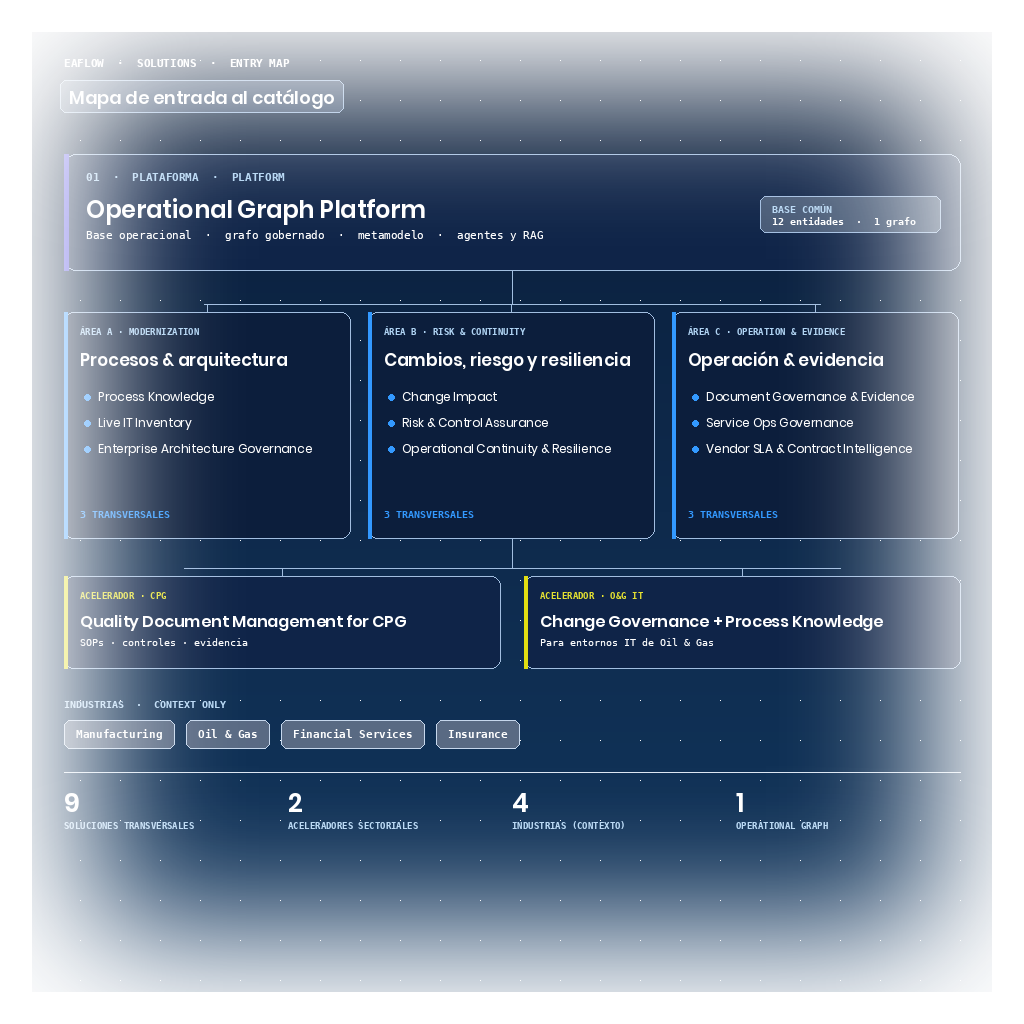
EAFlow catalog blueprint: Operational Graph Platform on top, three outcome areas of cross-industry solutions (modernization, risk & continuity, operation & evidence), representative accelerators (CPG QDM and O&G IT) and a context-only industries rail.
01 · Three entry points

Start with the entry point that best fits your context.

The same Operational Graph sits underneath every engagement, but the entry point depends on what you need: build the operational base, activate a cross-industry solution, or use an industry accelerator when sector context is proven.

Entry point 01 · Platform

Build the Operational Graph

Stand up the operational base: processes, applications, data, documents, risks, controls, owners and changes connected as one graph governed by your architects. Start here when no use case is prioritized yet, or when you want the model to operate transversally from day one.

Go to Operational Graph Platform ↓
Entry point 02 · Cross-industry solutions

Activate a cross-industry solution

Nine cross-industry solutions in three outcome areas: EA/BPA modernization, risk and continuity, operations and vendors. Start here when a concrete use case is already prioritized and you need scoped results before scaling.

Go to Cross-industry solutions ↓
Entry point 03 · Focused accelerators

Adopt a sector accelerator

Sector wrappers that combine cross-industry solutions with proven industry context: Quality Document Management for CPG, Oil & Gas IT. Start here when your industry already has a productized accelerator and the sector context is real.

Go to Focused Accelerators ↓
02 · Why it is not a vertical suite

A platform with modular applications and scoped accelerators — not an end-to-end vertical suite.

Three concepts hold the difference together: a common metamodel, a governed Operational Graph and agents grounded in graph traversal. That is what makes it possible to start with one concrete line without committing to a suite implementation.

01

Common metamodel

A standardized 12-entity-class ontology — processes, applications, integrations, data, documents, risks, controls, change control, tickets, contracts, vendors, projects — with owners and relationships as first-class graph properties.

02

Governed Operational Graph

The metamodel populated and continuously updated from your authorized connected systems. Productivity environments, ITSM platforms, traditional BPA tools and EA catalogs update the graph where the source system is authoritative.

03

RAG and agents over the graph

Retrieval grounded in graph traversal, not document chunking. When Max or an authorized agent answers a question, retrieval starts from a graph subset, not from a vector index of uploaded PDFs.

03 · Catalog

Platform, cross-industry solutions and accelerators on one Operational Graph.

One operational platform, nine cross-industry solutions in three outcome areas, and eight industry accelerators — four in the CPG area, two in Oil & Gas (Oil & Gas IT and Oil & Gas Industrial MOC), Fintech & B2B SaaS and Real Estate (PropTech). Each solution is independent — you can start with any concrete case.

Entry point 01 · Operational Graph Platform

Operational Graph Platform — the common base.

The platform offering is the Operational Graph itself. Every cross-industry solution and every industry accelerator below runs on this common base. If you start here, you build the operational model first — the horizontal solutions and vertical accelerators activate later.

00 · Operational Graph Platform Platform · Common base

Operational Graph Platform

The common base every cross-industry solution and industry accelerator runs on.

One operational model: processes, applications, data, documents, risks, controls, owners and changes connected as a single graph. Governed by your architects, queryable by Max and your authorized enterprise agents through MCP and API surfaces.

  • Pre-built operational ontology with 12 entity classes
  • Multi-system connectors live-syncing from authorized sources
  • Lineage and provenance per node and edge
  • Governance workflow on the graph itself
Explore the Operational Graph →
Cross-industry solutions — 9 solutions in 3 outcome areas

Cross-industry solutions — progressive modernization on the graph.

Nine solutions organized in three outcome areas. Each solution is independent: you can start with any concrete case without committing to a suite implementation.

Area 01 · EA/BPA Modernization

For companies that need to organize processes, architecture, live inventory and change impact without starting from scratch.

01 · Change Impact & Change Roadmap Cross-industry · Assisted implementation
Change Impact & Change Roadmap

Before you change anything, understand what gets affected.

EAFlow connects changes to applications, processes, data, integrations, vendors, risks and controls so you can prioritize decisions, reduce surprises and leave auditable evidence.

  • Impact analysis grounded in the graph
  • Approvals and notification by traversal
  • Initiative roadmap
  • Audit trail per sub-product
Read about Change Impact →
02 · Process & Architecture Modernization Cross-industry · Scoped engagement
Process & Architecture Modernization

Migrate legacy repositories to a live, governed foundation.

Transform existing models to BPMN 2.0, normalize value chains, define conventions, publish processes and connect them to applications, data, risks, controls, documents and decisions.

  • Assisted EPC/VAC to BPMN 2.0 migration
  • Governed process portal
  • Versioning and approval
  • Connection to the Operational Graph
Read about Process Modernization →
03 · Enterprise Architecture Governance Cross-industry · Assisted implementation
Enterprise Architecture Governance

Architecture repository, metamodel, traceability and governance.

Connect processes, capabilities, applications, data, integrations, risks and decisions in a live architecture repository with quality rules and impact analysis.

  • Configurable metamodel
  • Process-capability-application-data traceability
  • Impact analysis
  • Audit and provenance
Read about EA Governance →
04 · Live IT Inventory Cross-industry · Initial capability
Live IT Inventory

Applications, owners, criticality, processes, vendors and integrations.

Organize the technology portfolio into a live base for decision-making, without starting a heavy enterprise architecture implementation.

  • Application catalog
  • Owners and criticality
  • Supported processes
  • Integrations and dependencies
Read about Live IT Inventory →

Area 02 · Risk, Control & Continuity

Connect risks, controls, self-assessments, evidence and resilience with processes and real operations.

05 · Risk & Control Assurance Cross-industry · Assisted implementation
Risk & Control Assurance

Risks, controls, self-assessments, tests and evidence.

Connect risks, controls, owners, self-assessments, tests and evidence in one governed view. Traceability by process, area or subject.

  • Impact/probability matrix
  • Self-assessments and responses
  • Test results and evidence
  • Dashboards by subject and owner
Read about Risk & Control Assurance →
06 · Operational Continuity & Resilience Cross-industry · Assisted implementation
Operational Continuity & Resilience

BIA, RTO/RPO, BCP, DRP, drills and critical dependencies.

Connect critical processes, applications, risks, controls, BIA, RTO/RPO, BCP, DRP, drills and evidence in a live operational model.

  • BIA + RTO/RPO
  • BCP and DRP
  • Drill results
  • Resilience dashboard
Read about Operational Continuity →
07 · Document Governance & Evidence Cross-industry · Documents & traceability
Document Governance & Evidence

Official documents, versioning, approval, evidence and traceability.

Turn documents, procedures and evidence into governed knowledge with version control, approvals, official sources and audit traceability.

  • Governed document repository
  • Versioning and approvals
  • Deep links to official sources
  • Audit trail by traversal
Read about Document Governance →

Area 03 · Operations & Vendors

Govern operations, tickets, SLAs, providers and contracts without abruptly cutting the current ecosystem.

08 · Operational Graph for Service Operations Horizontal solution · Assisted implementation
Operational Graph for Service Operations

From isolated tickets to governed operations.

Horizontal solution to govern tickets, providers, SLA/OLA, knowledge, changes and governed agents on the Operational Graph.

  • Central ticket, distributed resolution
  • Integration by maturity with third parties
  • Governed agents with human control
  • SLA/OLA, evidence and operational reporting
Read about Operational Graph for Service Operations →
09 · Vendor, SLA & Contract Intelligence Cross-industry · Initial capability
Vendor, SLA & Contract Intelligence

Vendors, contracts, SLA, backlog and contractual compliance.

Manage vendors, contracts and SLAs with operational evidence. Show who responds, who falls short and what evidence backs each decision.

  • Vendor and contract catalog
  • SLA and OLA with scorecards
  • Backlog and aging per vendor
  • Auditable contractual compliance
Read about Vendor SLA & Contract Intelligence →
Entry point 03 · Industry Accelerators — 8 available

Industry Accelerators — sector wrappers built on cross-industry solutions.

Industry accelerators are sector wrappers that combine specific cross-industry solutions with sector context and integrations. Each accelerator is BUILT ON named cross-industry solutions — it is not a peer to them. Eight industry accelerators are available today: four in the CPG area (Quality Document Management, HR Workflow — Negotiated Off-boarding, Service Desk — Multi-actor, Budget Workflow — CAPEX/OPEX + ERP), two in Oil & Gas (O&G IT and Oil & Gas Industrial MOC), Fintech & B2B SaaS and Real Estate (PropTech).

05 · Quality Document Management for CPG Industry accelerator · CPG

Built onDocument & Evidence Management + Microsoft 365 + CPG documentary context

Quality Document Management for CPG

Manage documents, versions, approvals and evidence with Microsoft 365 context.

Application for document quality, version control and workflow on the Microsoft 365 / Graph context — built for CPG (consumer packaged goods), available through assisted implementation. Quality documentation already lives in SharePoint, OneDrive and Teams; EAFlow brings those documents into the Operational Graph with version, approval, owner and process linkage.

  • SharePoint and OneDrive integration
  • Version, approval and owner traceability
  • Document linkage to processes and controls
  • Audit-ready evidence trail
Read about Quality Document Management for CPG →
06 · HR Workflow — Negotiated Off-boarding Industry accelerator · CPG

Built onWorkflow Automation + Operational Graph + e-signature + audit trail by company entity

HR Workflow — Negotiated Off-boarding

Mutuo disenso, mutual separation, rupture conventionnelle — one flow, audit-grade evidence by company entity and country.

Industry accelerator for negotiated contract terminations in CPG multinational multi-entity organizations. Orchestrates the case flow between requesting manager, Payroll Administration and Payroll Approver; pushes the separation event to the corporate ERP/HCM through the service bus, with no core extension (clean-core S/4 compatible).

  • Visual workflow of the negotiated case
  • Form adapted by company entity and country
  • Multi-stakeholder audit trail + e-signature
  • HCM/ERP integration by service
Read about HR Workflow — Negotiated Off-boarding →
07 · Service Desk — Multi-actor Industry accelerator · CPG

Built onWorkflow Automation + Operational Graph + federated identity + external self-registration

Service Desk — Multi-actor Supplier & Internal Request Management

One queue, four roles, a graph that routes.

Industry accelerator for Shared Service Centers (CSC) that handle dense Tier-1/2/3 supplier chains and internal areas in CPG multinationals. External supplier self-registration, graph-assisted routing (company entity / category / focal point), ticket state machine and operational reporting. Runs alongside the ERP — does not replace SRM or Source-to-Pay.

  • External supplier self-registration
  • Multi-role queue with state machine
  • Graph-assisted routing
  • Controlled procedure for bulk cleanup
Read about Service Desk — Multi-actor →
08 · Budget Workflow — CAPEX/OPEX + ERP Industry accelerator · CPG

Built onWorkflow Automation + Operational Graph + ERP integration bus + classified reprocessing agent

Budget Workflow — Extraordinary CAPEX/OPEX Approval & ERP Integration

Multi-level chain by company entity. Integration to the financial backbone. Classified reprocessing.

Industry accelerator for extraordinary OPEX budget extensions and CAPEX approvals in CPG multinational multi-entity organizations. Approval chain configurable by company entity / cost center, master data editable through Continuous Improvement, integration with the corporate financial ERP (S/4 or ECC coexistence) and classified reprocessing agent. Clean-core S/4 compatible.

  • Multi-level chain by company entity / cost center
  • ERP integration by service (S/4 / ECC / hybrid)
  • Classified reprocessing agent
  • Continuous Improvement of master data with audited CRUD
Read about Budget Workflow — CAPEX/OPEX →
09 · O&G IT — Change Governance + Process Knowledge Industry accelerator · Oil & Gas IT

Built onChange Governance for IT + Process Knowledge + O&G IT application/integration inventory

O&G IT — Change Governance + Process Knowledge

IT change governance + process knowledge for Oil & Gas IT environments.

Industry accelerator: combines Change Governance + Process Knowledge for Oil & Gas IT contexts. Does NOT cover industrial OT, PSM, HAZOP, Bowtie, or Asset Integrity (the orchestration of the industrial MOC cycle lives in the Oil & Gas Industrial MOC accelerator).

  • IT change governance scoped for O&G
  • Process knowledge for O&G IT
  • Application, process and integration inventory
  • Clear boundary: no OT control
Read about O&G IT accelerator →
10 · Oil & Gas Industrial MOC Industry accelerator · Oil & Gas Industrial

Built onOperational Graph + Change Governance + Process Knowledge

Oil & Gas Industrial MOC

Orchestrates and makes the industrial Management-of-Change cycle auditable.

Connects risks, assets, the MOC committee, PSSR, evidence and approvals into a single auditable record, connected by Operational Graph. It is not a PSM/HAZOP/Bowtie/Asset Integrity engine and does not touch OT control.

  • MOC cycle: request → triage → risk → committee → implementation → PSSR → authorization → closure
  • Risk, safeguard, action and evidence connected in the same record
  • Exportable auditable record; specialist methodologies as input/evidence, not native engine
Explore Oil & Gas Industrial MOC →
11 · Customer Operations in Fintech & B2B SaaS Industry accelerator · Fintech & B2B SaaS

Built onOperational Graph + Max + CRM/Support Intelligence + Regulatory Operations + Partner Governance

Operational Graph for Customer Operations in Fintech & B2B SaaS

Connect CRM, support, Customer Success, integrations, regulatory changes, owners and evidence in a context layer — without touching the product core.

Industry accelerator for Fintech and B2B SaaS companies: connects CRM, support, Customer Success, integrations, regulatory changes, knowledge and evidence in an Operational Graph to make the operation that sells, implements and supports the business more efficient. It does NOT replace the CRM, helpdesk, data lake, GRC or product core — it connects them.

  • CRM & Support Intelligence + Regulatory Operations Impact
  • API & Partner Operations Governance + Change Impact
  • Post-M&A integration and Governed AI for Customer Operations
  • Accelerator scoped to 2 or 3 critical flows
Read about the Fintech & B2B SaaS accelerator →
12 · Real Estate Sales Operations Vertical PropTech

Built onOperational Graph + agentic orchestration + CRM/channels + real estate inventory + human-in-the-loop

Real Estate Sales Operations

Convert dispersed real estate demand into managed opportunities.

Run leads, properties, visits, follow-up and CRM on a single traceable commercial layer, with governed AI agents and human handoff.

  • Lead intake and immediate multi-channel response
  • Qualification and inventory matching
  • Automated follow-up and visit scheduling
  • Executive reporting + human handoff for closing
Explore Real Estate Sales Operations →

Delivery path · Not a product category

Custom Delivery — when no product fits cleanly

Some industries don't have a productized accelerator yet. EAFlow can run a scoped delivery engagement on the Operational Graph — co-built with your team, on the same graph the products use, with explicit boundaries on what is and isn't covered. Custom Delivery is how visitors from non-productized industries start a conversation.

It is NOT a 4th product card. It is a delivery path on the same common base, scoped to your context.

Start a scoped delivery conversation →
Industry context — where solutions apply

Industry context.

Two distinct ways industries appear on EAFlow: industries where cross-industry solutions apply (broad list — no productization implied), and industries with a productized accelerator (narrow list — today: CPG, Oil & Gas, Fintech & B2B SaaS and Real Estate).

A · Industries where cross-industry solutions apply

Financial ServicesInsuranceRetailHealthcareLife SciencesManufacturingMiningOil & GasCPGPublic SectorEnergyTelecomLogistics

No accelerator for your sector yet?

Some industries don't yet have a productized accelerator on EAFlow. If your sector is regulated, asset-intensive, or has scope-dependent operational requirements where no cross-industry solution or accelerator fits cleanly, Custom Delivery may be possible — as a scoped Operational Graph engagement, not as a vertical suite or operational-technology control system. Talk to us about your context.

We don't replace everything. We connect what already exists.

Your current tools, repositories, models, tickets, documents and data sources can keep operating. EAFlow adds a layer of progressive modernization: context, governance, traceability, evidence and AI over the company's operational graph.

04 · Assisted implementation

How it is implemented: three steps on the same graph.

EAFlow's solutions are delivered through assisted implementation, not shrink-wrapped. Every engagement understands your operational context, connects the authorized sources to the graph, and tunes the solution to how your organization actually operates.

Step 01

Scoped discovery

We map the operational context relevant to the solution — which processes, applications, documents and changes matter for the use case you need to solve.

Step 02

Source connection

We connect the systems that hold your context (process repositories, Microsoft 365, service management, change workflows) to the Operational Graph. Scoped to what you authorize.

Step 03

Assisted implementation

We work alongside your team during the first deployment, tuning the solution to your operations and transferring ownership as adoption matures.

Solutions on the Operational Graph. Assisted implementation. No shelf promises.

Years of knowledge stuck in legacy platforms?

Progressive modernization is the entry point into EAFlow.

Modernize legacy repositories →

Start with a concrete case. Expand as the model matures.

Nine cross-industry solutions in three outcome areas. Eight industry accelerators (CPG ×4 + Oil & Gas ×2 [IT + Industrial MOC] + Fintech & B2B SaaS + Real Estate). One Operational Graph as the foundation. Each engagement is built to your organization's scope.

EAFlow LLC delivers cross-industry solutions, industry accelerators and Custom Delivery engagements on the Operational Graph, with assisted implementation. Each engagement is built to your organization's scope.