EAFLOW · SOLUTIONS · CROSS-INDUSTRY SOLUTION · AREA 01

Enterprise Architecture Governance.
Live repository,
continuous governance.

Connect processes, capabilities, applications, data, integrations, risks and decisions in a live architecture repository. Built on Operational Graph. Operate enterprise architecture with traceability, quality rules, impact analysis, continuous governance and contextual assistance on trusted sources. Cross-industry solution in Area 01 — EA/BPA modernization. Assisted implementation.


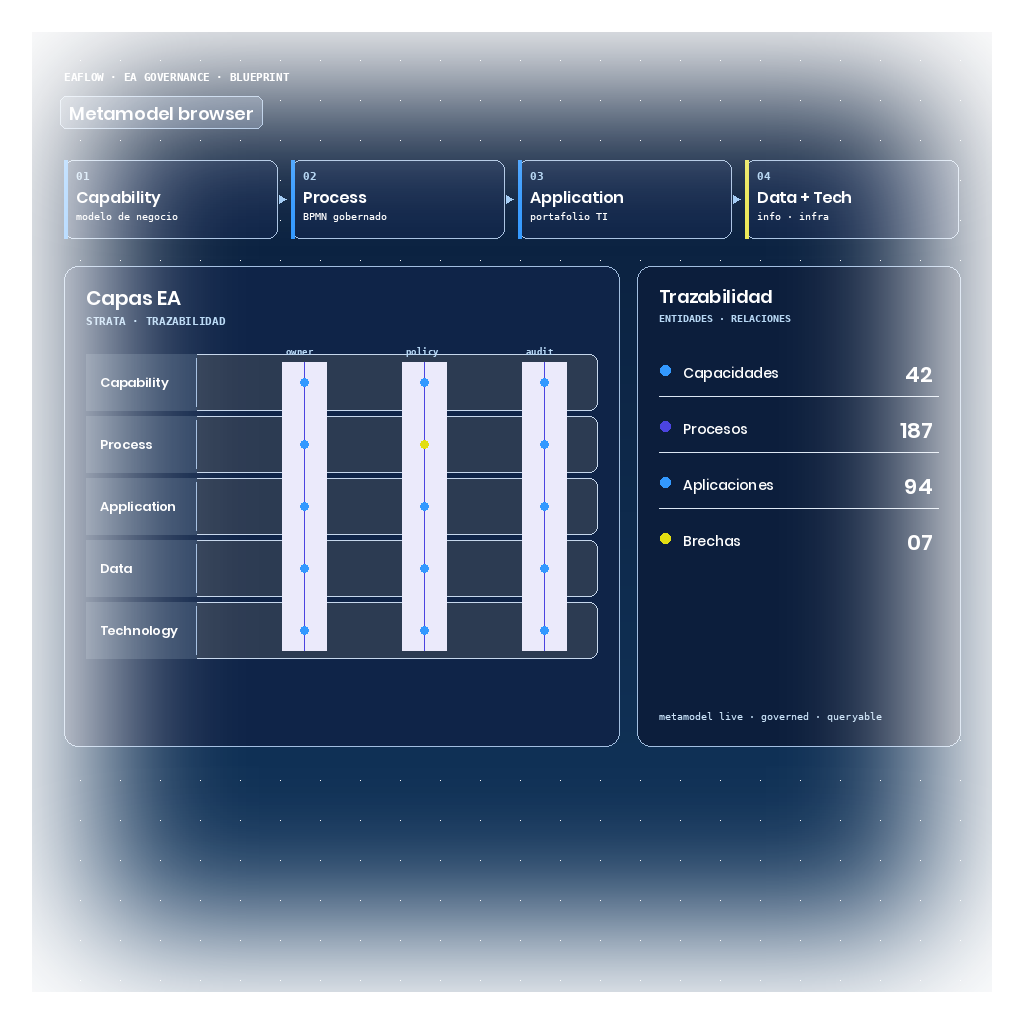
EAFlow blueprint with a metamodel browser: five EA layers (capability, process, application, data, technology) crossed by governance columns (owner, policy, audit) and a side panel with traceability counts.
Category
Enterprise architecture governance
Users
Enterprise architects, IT portfolio managers, IT governance
Output
Live EA repository, governed metamodel, traceability and impact analysis
Implementation
Packaged app with assisted implementation
Does not replace
Your current EA tool; adds governance and traceability layer on the graph

01 · What it is

Most architecture repositories are static documents.
Enterprise Architecture Governance is not.

In most organizations, the architecture repository lives in presentations and spreadsheets that nobody updates. When a change arrives, nobody knows which applications support which processes, who owns each domain or what decisions led to the current state. Impact analysis gets reconstructed from scratch every time.

Enterprise Architecture Governance connects processes, capabilities, applications, data, integrations, risks and decisions in a single Operational Graph. The repository is a live model that updates with every governance decision — not a document that ages. Quality rules are enforced continuously, not in annual audits. Impact analysis is a query, not an interview.

An architecture repository that governs itself as your team makes decisions.

02 · Graph context

The graph entities that Enterprise Architecture Governance connects.

The repository does not create a parallel data model. It operates on the same Operational Graph that already holds your processes, applications, data, documents and owners. These are the entities that architecture governance connects and keeps live:

  • Processes · The work flows that define how the organization operates
  • Capabilities · The organizational abilities that processes enable
  • Applications · The systems that support processes and capabilities
  • Data · The information consumed and produced across the chain
  • Integrations · The links between applications and systems that move data and events
  • Owners · The domain accountable parties who govern each layer of the repository
  • Standards · The quality and completeness rules applied over the model
  • Decisions · The governance records that trace why the repository is as it is

When an architecture decision is recorded on the graph, the relationships between entities update in a traceable way. Governance is a query to the graph, not a meeting where someone has to remember.

03 · What's included

Operational capabilities from an Enterprise Architecture Governance project.

An Enterprise Architecture Governance project produces eight operational capabilities on your Operational Graph. Each one is built on the existing graph and remains in the hands of your team at project close.

Applies in: financial services, manufacturing, oil and gas, retail, consumer goods — wherever enterprise architecture requires traceability and continuous governance.

  • Enterprise architecture repository

    A live repository that connects processes, capabilities, applications, data, integrations, risks and decisions in a single model. Not a static document: a graph that updates with every governance decision.

  • Configurable metamodel

    The metamodel adapts to your context: entity types, permitted relationships, mandatory fields and proprietary taxonomies — without forcing the organization to fit an external standard it does not use.

  • Process-capability-application-data-integration mapping

    Each repository node connects upward to the capabilities it enables and downward to the applications, data and integrations that support it. Traceability crosses layers rather than remaining trapped in silos.

  • Quality and completeness rules

    The repository applies configurable rules: which fields are mandatory, which relationships must exist, which nodes are incomplete. Model quality is a queryable state, not an opinion.

  • Domain governance

    Each architecture domain has its accountable owner, its rules and its perimeter. Governance is not global and diffuse — it is specific by domain, with clear roles and bounded permissions.

  • Impact analysis

    When a change touches the repository, the graph surfaces which processes, applications, data and integrations are affected — without reconstructing the analysis from scratch each time.

  • Repository health metrics

    Dashboards that show completeness by domain, relationship coverage, nodes without an owner, violated rules and model evolution over time. Repository health is visible, not assumed.

  • Audit and provenance

    Every change to the repository is recorded: who made it, when, what the prior state was and what the current state is. Provenance is a by-product of governance, not a separate project.

03b · Questions this enables

Questions this solution enables you to answer.

  • Which processes depend on this application?
  • Which data is affected by a change?
  • Which business capabilities does this system support?
  • Where are owners, attributes or critical relationships missing?
  • What architecture do we have today and what should change first?

04 · Delivery

Assisted implementation. Bounded project. Ownership transferred.

Enterprise Architecture Governance is delivered as a bounded project, not as a platform subscription. EAFlow works alongside your team to bring the selected architecture domain onto the Operational Graph, configure the metamodel and governance rules, and transfer ownership at close. The result is operated by your people, not by us.

Discovery

Scope on your current repository

We identify the architecture domain where the repository is most out of date or where decision-making suffers most from lack of visibility. Scope is declared on what already exists — not on a blank spreadsheet.

Configuration

Metamodel and quality rules

We configure the metamodel to reflect your context: entity types, permitted relationships, mandatory fields, completeness rules and domain owners. This augments your existing architecture modeling platform — it does not replace it.

Adoption

Governance transferred to your team

We deploy the repository on your Operational Graph, configure the continuous governance flows and transfer ownership so your team operates the solution independently. Assisted implementation, then your hands on the wheel.

Delivered through bounded projects. Ownership stays with your team after handover.

Industry context

Industry pages where this solution applies

Reference pages explaining how the Operational Graph applies in each sector. Enterprise architecture governance is cross-industry.

Architecture governance EA repository Impact analysis EA/BPA modernization Portfolio audit EA traceability

Bring an architecture domain to the table. We walk through what the Operational Graph would surface about your current repository and what an assisted governance implementation could look like for your organization.

Enterprise Architecture Governance is delivered as an assisted implementation on the EAFlow Operational Graph. It augments your existing architecture modeling platform — it does not replace it.