



Requester / Originator
Was my change classified and routed correctly?
Capture, triage and classification (MOC / not MOC / replacement-in-kind / emergency) with the right route from the start.
Built for exploration, production, refining, transport and distribution companies in oil and gas that need to govern industrial changes with full traceability from the initial request through to start-up authorization. EAFlow connects risks, assets, facilities, processes, MOC committee, actions, evidence, PSSR and operational approvals in a single auditable context — connected by Operational Graph.
01 · Problem
In oil and gas, changes do not happen on isolated documents. They affect industrial assets, process facilities, critical equipment, control systems, operating procedures, energy infrastructure, contractors and multidisciplinary teams.
The challenge is not logging the change: it is demonstrating that every change was correctly classified, assessed, approved, implemented and authorized for start-up — with sufficient evidence, clear owners and full traceability.
When that traceability ends up fragmented across spreadsheets, emails, documents, meetings and isolated systems, the MOC loses control, context and auditability.
The problem is not starting a MOC. It is sustaining traceability through to start-up.
02 · Map
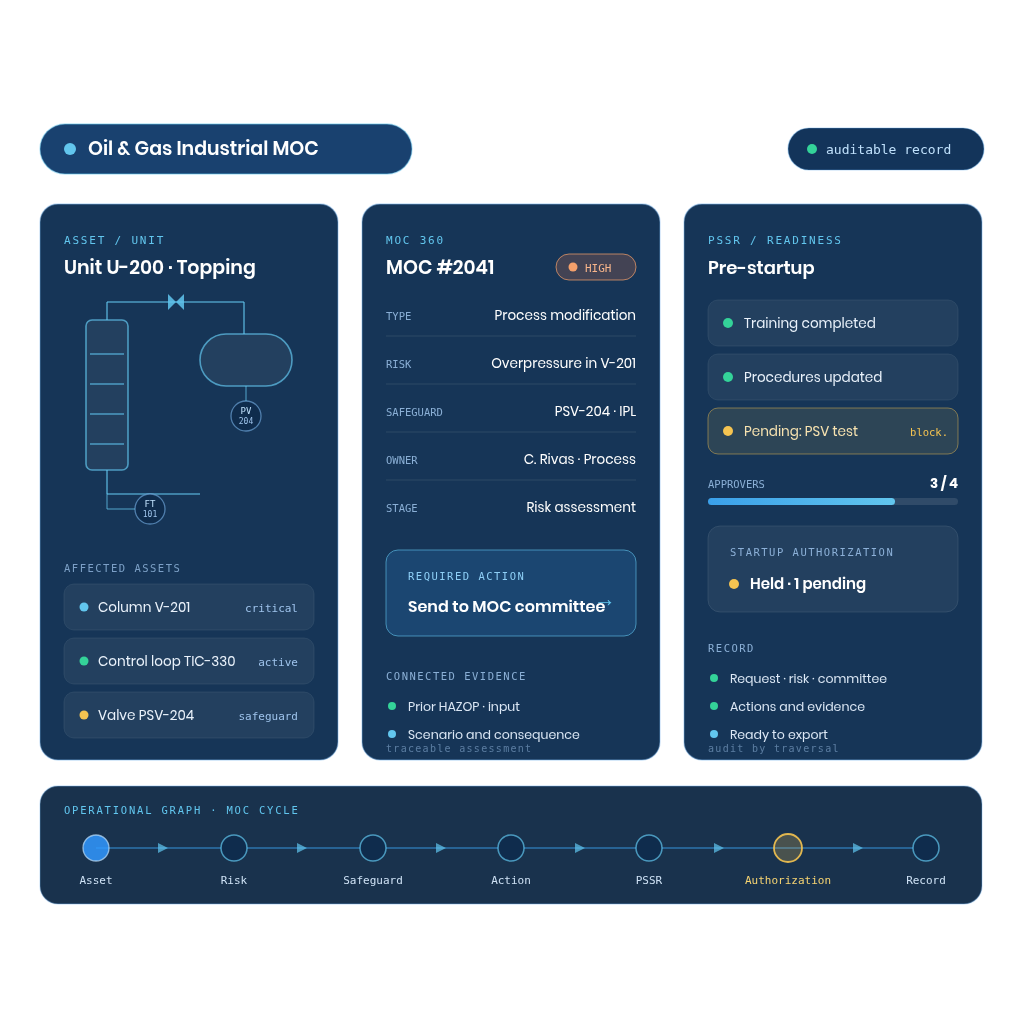
EAFlow does not treat the MOC as an isolated request. Every change is connected with the assets, facilities, processes, risks, documents, owners, evidence and authorizations that surround it.
The result is a live, connected and auditable MOC record from the initial request through to closure.
03 · Deliverables
From the initial request to the auditable record, EAFlow turns a fragmented cycle into concrete deliverables for assessment, committee, implementation, readiness and audit.
Full governance of the MOC cycle: request, classification, assessment, committee, implementation, PSSR, authorization, closure and an auditable record.
Structured logging of risk scenarios, causes, consequences, safeguards, required actions and residual risk. Specialist methodologies (PSM/HAZOP/Bowtie) are incorporated as input and evidence — EAFlow does not run them natively.
Multidisciplinary review with participants, votes, conditions, minutes, signatures and traceable decisions.
Tracking of actions, owners, due dates, evidence, deviations and verification against the approved design.
Pre-start-up validation with checklist, training, critical open items, required approvers and start-up authorization.
A complete record with request, analysis, approvals, evidence, PSSR, closure, history and export for internal or regulatory audits.
When to use
Oil & Gas Industrial MOC does not apply if:
04 · Roles
The accelerator structures the conversation between the person originating the change, the committee that assesses it and the person who authorizes start-up.
Was my change classified and routed correctly?
Capture, triage and classification (MOC / not MOC / replacement-in-kind / emergency) with the right route from the start.
Do I have the risk, safeguards and actions in view to decide?
Scenarios, safeguards and actions connected to the case; votes, minutes and conditions stay traceable.
Is everything ready and authorized to start up?
PSSR as the readiness gate: blocking open items separated from mitigated ones, required approvers and a recorded authorization.
05 · Implementation
The solution organizes the MOC experience into five visible steps: request and triage · risk assessment · committee and approvals · implementation and PSSR · closure and record.
01 · Mapping
Assets, facilities, processes, risks, committee, PSSR and readiness are declared on your Operational Graph, not on a slide.
02 · Connection
The outputs of your existing methodologies and systems (EDMS, ERP, risk tools) are logged as input and evidence of the record. We do not replace those systems: we connect them.
03 · Operation
Every change stays traceable from the request through to start-up authorization and the generation of the final exportable record.
Industry accelerator · assisted implementation · first scoped case.
06 · Path
The MOC record follows a known sequence: request, triage, risk assessment, committee, implementation, the PSSR readiness review and start-up authorization. BPMflow sustains the path between those milestones, keeping visible who has to act, which deadline is running, which evidence is missing and which condition remains open. The committee decision and the fulfilment of its conditions are different milestones: approving a change with conditions does not close the record — it leaves obligations in force with owners assigned. The PSSR readiness review brings that verification together, and start-up authorization remains a human decision on record, with the status of every open condition in view.
Where it applies
It applies across the hydrocarbons chain, where changes cross assets, facilities, processes, risks and authorizations.
Existing tools
It does not replace your document EDMS, your ERP, your historian, or the specialist process-safety methodologies. It is not a native PSM, HAZOP, Bowtie or Asset Integrity engine either, nor does it touch OT / SCADA / PLC control. EAFlow orchestrates the MOC cycle and logs the outputs of those systems as input and evidence of the auditable record.
Process-safety and integrity engines live with sector specialists. EAFlow contributes orchestration, traceability and the record.
We take a scoped industrial MOC scenario and make it fully traceable — from the request through to start-up authorization.
Oil & Gas Industrial MOC — an EAFlow industry accelerator, assisted implementation on the Operational Graph. It is not a PSM/HAZOP/Bowtie/Asset Integrity engine and does not touch OT control.