


EAFLOW · SOLUTIONS · CROSS-INDUSTRY SOLUTION · AREA 01

Process Knowledge
Modernize processes and operational documentation
into a governed, traceable knowledge layer queryable with AI.

EAFlow helps organizations across three scenarios: ordering processes scattered in documents and folders, replacing legacy BPA tooling, or maintaining governed coexistence with an existing repository while enabling a higher layer of publishing, documentation and AI. In every case the objective is the same: turning processes, documents and official sources into operational knowledge connected to the Operational Graph and queryable with Max.

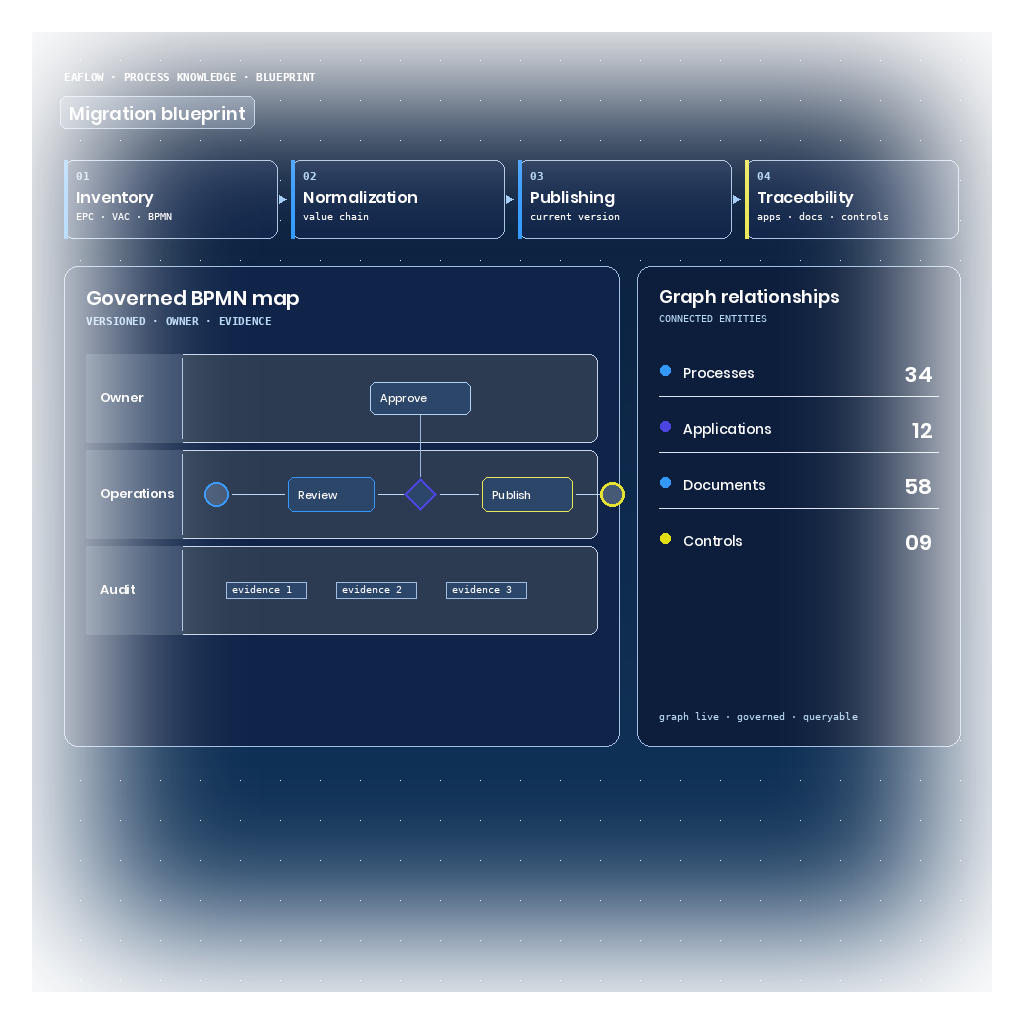
EAFlow Process Knowledge blueprint: 4 step-pills (Inventory · Normalization · Publishing · Traceability), a Governed BPMN map with Owner/Operations/Audit swim-lanes, and a Graph relationships panel counting Processes, Applications, Documents and Controls.
Category
Process Knowledge for processes and operational documentation
Users
Processes, quality, operations, documentation and governance
Output
Process Portal, connected documents, Operational Graph and Max
Implementation
Three scenarios: starting a practice, legacy BPA replacement or governed coexistence
Does not replace
BPA tooling or document repositories already in place; complements them when they remain the official source

01 · Adoption scenarios

Three scenarios. One shared base of Process Knowledge.

Adoption adjusts to the real starting point of the organization. A single migration path is not sold across the board; the route is defined by the applicable scenario.

There is no need to turn the current tool off to get started.

Starting a process practice

Situation: Documents, folders, spreadsheets, simple diagrams, procedures and scattered quality repositories. There is no formal process practice yet.

What EAFlow does: Orders documentation, structures a process architecture, generates AI-assisted BPMN and connects processes with documents, roles and systems on the Operational Graph.

Legacy BPA replacement

Situation: Enterprise BPA tooling with years of models, attributes, relationships and proprietary diagrams; maintenance cost already exceeds the value it generates.

What EAFlow does: Migrates models, relationships, attributes and documentation into EAFlow, normalizing to BPMN 2.0 where applicable. The migration can run as a full cutover or in waves, per domain.

Governed coexistence

Situation: The legacy tool stays as the edit source because the current method remains valid; the priority is to add publishing, documentation and query without replacing the tool.

What EAFlow does: Keeps the existing edit source, synchronizes, publishes, connects official documentation and enables Process Knowledge, Operational Graph and Max as a higher knowledge layer.

Legacy BPA replacement can run as a full cutover or as a progressive wave-based replacement — these are sub-modalities inside the same scenario, not separate global routes.

The route changes with the starting point. The base is the same: processes, operational documentation, the Operational Graph and Max.

02 · Problem

Process knowledge does not live in the diagram alone.

A diagram shows the flow. But the real operation also depends on attachments, instructions, policies, SOPs, forms, evidence, owners and documents published in corporate repositories.

EAFlow connects those elements so the process stops being an isolated view and becomes queryable operational knowledge.

In Service Operations, this enables searching knowledge before opening tickets, suggesting relevant articles, connecting incidents to current procedures, and feeding improvement loops across ticket, problem, root cause, workaround and reusable knowledge. Max answers from official sources and published knowledge, not from drafts or ungoverned content.

From the resolved ticket to reusable knowledge. From reusable knowledge to fewer repeated tickets.

03 · From attachments to knowledge

From linked attachments to queryable knowledge.

Operational documentation typically lives as links or attachments without process context. Process Knowledge promotes each document through four stages, while keeping SharePoint or another existing document repository as the official source where applicable.

  1. 01

    Traditional link

    A process links a document via URL or attachment. Freshness, responsible owner and process context stay outside the link.

  2. 02

    Connected document

    EAFlow connects the document to the process, the responsible role and the involved applications. The official source can remain in the existing document repository.

  3. 03

    Governed document

    It is versioned, approved with signature, published with effective date and indexed against the Operational Graph. Traceability exists at the event level.

  4. 04

    Document queryable with Max

    Max answers about the content with process context, cites the current version and shows the responsible owner and related documents.

A link is not knowledge. A document connected to the process, indexed, governed and queryable by Max is. The document repository can remain the official source; modernization does not require replacement.

The value is not in uploading documents to another repository. The value is in connecting each document to the process it supports.

Mechanism · What EAFlow modernizes

Not everything has to convert to BPMN. Each artifact has a clear nature.

A legacy repository typically combines several artifact types. Process Knowledge separates what is normalized to portable BPMN 2.0, what stays as navigable architecture and what moves to the Operational Graph as a governed entity.

  • VAC / value chains

    Preserved as navigable architecture and a drill-down layer over the graph.

    No direct BPMN conversion is promised — value chains keep their structural role.

  • EPC / proprietary flows

    Normalized to portable BPMN 2.0 with rules, equivalences and exception validation.

    Assisted, governed migration with an explicit report on cases that do not migrate cleanly.

  • Extended BPMN

    The core is taken to portable BPMN 2.0.

    Modeler-specific extensions and metadata move to the Operational Graph as first-class properties.

  • SOPs, policies, instructions, attachments

    Connected to the process, responsible role and applicable control. They can remain in the existing document repository.

    EAFlow adds governance, versioning and queries with citations over the official source — without migrating files when not required.

04 · Operational Graph

BPMN models the flow. The Operational Graph connects the context.

BPMN lets the flow be standardized. The Operational Graph connects what supports that flow: documents, roles, applications, data, owners, controls, evidence and relationships between processes.

  • Processes · The portable BPMN 2.0 flow — the navigable core of the repository
  • Roles · Who is accountable, executes, approves or consults each step
  • Systems · The applications that support the flow and the data they produce
  • Data · The information the process consumes and produces, with its data quality owner
  • Documents · Procedures, instructions, evidence and manuals that anchor the process
  • Relationships · Cross-cutting connections across processes, documents, systems, data and evidence

The graph is what keeps the architecture current when models migrate, owners rotate and applications evolve. The architecture updates with the business, not in spite of it.

05 · Max

Max queries the process and its published official sources.

Max answers about the modernized processes and the associated documentation with context from the Operational Graph and citations to the current version, related documents and the responsible owner. It is not an assistant that "knows" processes — it is a query layer that traverses the graph and returns backed evidence.

  • Which current document applies to this activity?
  • Which instruction should this role use?
  • Which policy supports this step?
  • Which attachments are associated with this process?
  • What changed compared to the previous version?
  • Which processes depend on this document?

Extension: on the same base, EAFlow can connect risks, controls and evidence when they are in scope. The starting point is Process Knowledge — processes and operational documentation on a single governed layer.

06 · Deliverables

Governed deliverables, from diagnostic to adoption or replacement plan.

A Process Knowledge engagement produces governed operational deliverables, aligned to the applicable scenario. Each one is built on authorized sources and is owned by the responsible team at the end.

  • Diagnostic of the starting point

    Assessment of the applicable scenario (starting practice, legacy BPA replacement or governed coexistence), the heritage or scattered repository, and the associated document sources with freshness and ownership per document.

  • Map of processes and documentation

    Inventory of in-scope processes and associated document sources — repositories, BPA tools, official folders — with present notations and model quality.

  • Process architecture

    Hierarchical structure of the process architecture with value chains, decomposition levels, owners and cross relationships — preserved as a navigable layer over the graph.

  • BPMN models where applicable

    Diagrams normalized to portable BPMN 2.0, with equivalence rules, exception validation and an explicit report on cases that do not migrate cleanly.

  • Connected operational documentation

    SOPs, policies, instructions and evidence connected to the process, the responsible role and the applicable control — they can remain in the existing document repository as the official source.

  • Operational Graph

    Processes, roles, systems, data, documents, evidence and relationships connected as first-class entities with event-level traceability.

  • Max activated over official sources

    Natural-language query over the modernized processes and the associated documentation, with citations to the current version and the responsible owner.

  • Adoption or replacement plan

    Roadmap with waves, dependencies, progression criteria, applicable scenario (starting, replacement or coexistence) and governance model transferred to the responsible team at the end.

When to use

Use Process Knowledge when:

  • Modeled processes exist, but the documentation lives in another repository.
  • Process attachments are just links.
  • Users do not know which document is current.
  • Processes and documents need to be queried from a single experience.
  • The organization wants to keep existing tooling but add governance, context and AI.
  • A progressive migration without big bang needs to be prepared.

07 · Roles

Three roles. One shared knowledge base.

Process Knowledge serves three roles in the organization; each one reaches the same modernized base of processes, documents and relationships, with the depth that matches its responsibility.

Architecture and processes

Model, govern and evolve the process architecture, the relationships on the Operational Graph and the equivalence rules toward portable BPMN 2.0.

Business users

Consult processes, documents, responsible owners and official sources without navigating multiple systems; find the current version from a single experience.

Quality, audit and governance

Access current documentation, traceability, evidence and relationships with processes; verify that every decision is signed and cited on the graph.

08 · Delivery

Implementation with hands-on partnership. The responsible team owns the operational model.

Process Knowledge is delivered as a scoped wave-based engagement. EAFlow works alongside the responsible team to assess the applicable scenario, agree on equivalence rules where applicable, run the pilot and advance adoption per the chosen scenario — with assisted validation at every step and ownership handoff at the end.

Diagnostic

Starting point and applicable scenario

We assess the real state of the repository or scattered documentation, identify the notations present and declare which of the three scenarios applies: starting a practice, legacy BPA replacement or governed coexistence.

Pilot

Equivalence rules + Operational Graph pilot

We agree on equivalence rules where applicable, run a scoped pilot with assisted validation and publish the subset to the portal with owners signing off on freshness.

Adoption in waves

Adoption, replacement or synchronization

We advance in waves per the chosen scenario — starting practice, legacy BPA cutover or wave replacement, or governed coexistence with the source tool as edit source — and transfer operational ownership to the responsible team.

Assisted implementation. Ownership transferred to the responsible team at the end of the engagement.

Scenarios

Scenarios where Process Knowledge adds value

Applies in contexts where processes and operational documentation need to stay connected, governed and queryable without replacing existing BPA or document tooling.

Legacy BPA modernization Process portal Operational document management Quality and SOPs SharePoint / M365 Document audit Enterprise architecture Change management

Starting point

Process Knowledge can start, replace or extend the current process practice depending on the starting point.

EAFlow can start a process practice when no formal tool exists, replace a legacy BPA by migrating models and attributes into portable BPMN 2.0, or maintain governed coexistence with the current tool while enabling a higher layer of knowledge, documentation and AI.

The source tool can remain as the edit source, be replaced via cutover or in waves, or simply not exist yet; the decision stays with the responsible architecture team, per the applicable scenario.

Before creating another repository, turn the knowledge that already exists into an operational capability.

EAFlow identifies the starting point — scattered documentation, legacy BPA or governed coexistence — and defines the route to activate Process Knowledge with processes, documentation, the Operational Graph and Max.

Process Knowledge is delivered as a scoped wave-based engagement on the EAFlow Operational Graph. The BPA tool and document repository can remain the official source, be replaced via cutover or in waves, or simply not exist yet when the scenario is starting a practice.