
EAFLOW · SOLUTIONS · CROSS-INDUSTRY SOLUTION · AREA 02

Risk & Control Assurance
Risks, controls and evidence
connected to the process.

EAFlow connects risks, controls, processes, owners, tests, findings, action plans and published evidence in a governed assurance layer on the Operational Graph. Risk & Control Assurance enables starting a control practice, coexisting with an existing GRC platform, or extending it with operational context, current documentation and querying with Max — without requiring a full migration from day one.

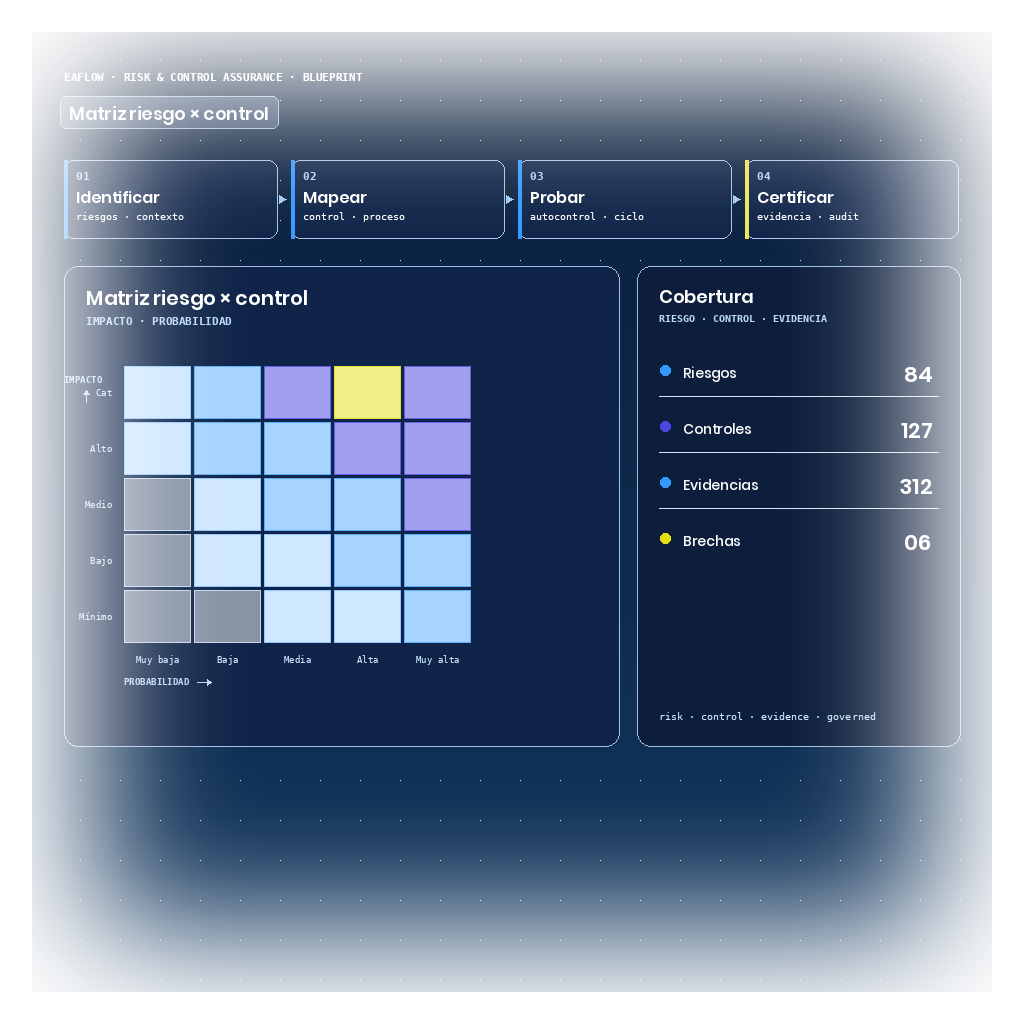
Risk & Control Assurance blueprint: risk-control matrix connected to processes, owners, tests and published evidence on the Operational Graph.
Solution type
Horizontal solution for risk and control assurance.
Differentiator
Operational Graph + documentary evidence + Max over official sources.
Outcome
Risks, controls, processes, owners, tests and evidence in a traceable view.
Adoption
Three scenarios: starting, GRC coexistence or progressive extension.
Coexistence
Does not necessarily replace the existing GRC; adds context, evidence and traceability.

01 · Adoption scenarios

Three scenarios. One shared base of Risk & Control Assurance.

Adoption depends on the real starting point of the Risk, Internal Control, Compliance or Audit team. EAFlow does not require a full migration nor replacing the existing GRC system. It allows starting with a layer of processes, controls and evidence connected to the Operational Graph.

There is no need to switch off the current platform to get started.

Starting a risk and control practice

Situation: Risks and controls captured in spreadsheets, folders and scattered reports. No formal assurance practice with shared traceability yet.

What EAFlow does: Orders the risk-control universe, connects risks with processes, owners and documentary evidence, and lays down a first layer of tests, findings and action plans on the Operational Graph.

Coexistence with an existing GRC platform

Situation: A corporate GRC platform already exists and remains the official source for risks, controls or audit. The priority is to add operational context, evidence and querying without replacing it.

What EAFlow does: Connects the existing risk-control universe to the Operational Graph, adds documentary evidence linked to the process, and enables querying with Max over published evidence and controls.

Progressive extension by domain

Situation: Specific domains —operational risk, internal control, process audit, document compliance, third parties or continuity— need more operational context, traceability and connected evidence than the current system provides.

What EAFlow does: Extends the chosen domain with risks, controls, processes, evidence, tests and action plans on the Operational Graph. In some cases, this evolution can reduce dependency on legacy platforms in specific domains.

The route changes with the starting point. The base is the same: risks, controls, processes, evidence, tests, findings, action plans and querying with Max on the Operational Graph.

02 · Problem

The problem is not recording risks. It is demonstrating how they are controlled.

Many organizations have risks, controls and evidence recorded — but not connected. The risk lives in one matrix, the control in another, the evidence in folders, the process in a BPA tool or PDF, and the finding in an audit report.

The difficulty appears when Risk, Internal Control or Audit need to answer quickly:

  • Which control mitigates this risk?
  • Where is the current evidence?
  • Which process sustains this control?
  • Who is the accountable owner?
  • Which test was executed?
  • Which finding is still open?
  • Which action plan is overdue?
  • What can an auditor review?

Risk & Control Assurance turns scattered matrices and evidence into a connected, traceable and queryable assurance layer.

03 · Risk in the graph

Risk and controls as nodes in the Operational Graph.

In a traditional GRC, the risk usually stays as a record. In EAFlow, the risk becomes a connected operational entity.

Each risk can link to process, control, owner, area, evidence, test, result, finding, action plan, current document and querying with Max.

  • Risk · Inherent and residual risk connected to the process, subject and domain that originates it
  • Control · The control mechanism with owner, type, frequency and implementation status
  • Process · The operational process that executes or is affected by the control
  • Owner · The process owner, risk owner and control owner accountable for each node
  • Evidence · Published and current documentation that backs the control and the test
  • Test · Test or self-assessment result with date, evidence and conclusion
  • Finding · Audit or internal-control observation linked to the risk, control and process involved
  • Action plan · Remediation commitment with owner, due date and closure evidence
  • Current document · Policy, procedure or work instruction in published version that defines how the control must operate
  • Query with Max · Question resolved over published evidence and controls, with citation to the node and the source

The Operational Graph does not only show relationships: it uses them to explain coverage, gaps, evidence, owners and exposure.

04 · Process Knowledge lite

Process Knowledge lite for Risk and Audit.

Risk & Control Assurance includes a lightweight base of processes and operational documentation. It does not require deploying the full Process Knowledge practice nor migrating every process in the organization.

It enables connecting controls with processes, procedures, policies, work instructions, evidence and owners. Risk and Audit can navigate from a control to the process that executes it, the evidence that supports it and the current document that defines how it must operate.

It is not only about having a control matrix. It is about demonstrating the control in its operational context.

05 · Capabilities

Capabilities for risk and control assurance.

  • Risk-control universe

    Risks, controls, domains, subjects and processes registered as connected nodes on the Operational Graph. The universe stops being a spreadsheet and becomes a navigable layer.

  • Risk-control-process matrix

    Each risk is connected to the control that mitigates it and the process that executes it. Coverage, gaps and orphans appear as a graph query, not as a manually assembled report.

  • Documentary evidence

    Procedures, policies, work instructions, records and published backups are linked to the control and the process. Current evidence stays versioned, traceable and queryable as an official source.

  • RCSA and self-assessments

    Risk and control self-assessment questionnaires, with responses, "No" counts, design evaluation and gaps highlighted on the graph, not in a parallel spreadsheet.

  • Control tests

    Test results (passed, failed, not applicable) associated with the control, with attached evidence, executor and date. Control effectiveness no longer depends on a loose PDF.

  • Findings and action plans

    Audit or internal-control findings connected to the risk, control and process. Every action plan records owner, closure date, evidence and remediation status.

  • Audit and traceability

    The audit trail risk → process → control → test → evidence → finding → plan is traversed on the graph. Audit stops being a reconstruction project and becomes a query.

  • Max over published evidence

    Natural-language query over published evidence, controls, procedures, findings and action plans. Max answers from current documents and official sources, not from drafts.

  • Assurance reporting

    Dashboards by subject, domain, area, owner, process or control framework. Assurance reporting is built on the same graph, without manual extracts.

06 · Max over published evidence

Max over published evidence and controls.

Teams can ask Max about controls, evidence, procedures, findings and published action plans.

Max answers from current documents, official evidence and Operational Graph relationships. It does not work over drafts or obsolete versions when the answer requires governed evidence.

  • Which control mitigates this risk?
  • Which evidence supports this control?
  • Which process executes this control activity?
  • Which findings are still open?
  • Which action plan is overdue?
  • Which current document defines this procedure?

Max is not a generic search engine. It is an operational chat grounded in published evidence and official documents.

07 · Scope

Supported product scope.

  • Risks and controls.
  • Processes and owners.
  • Documentary evidence.
  • Tests and self-assessments.
  • Findings and action plans.
  • Assurance reporting.
  • Querying with Max.
  • Coexistence with existing GRC platform.

Risk & Control Assurance does not necessarily replace existing GRC platforms. It can operate as a connected assurance layer over current sources, or as a progressive base for specific risk/control domains.

08 · Adoption

Adoption without a big bang.

EAFlow enables starting from a bounded domain: operational risks, internal controls, process audit, document compliance, third parties or continuity. Scope is defined by subject, process, area, unit, control framework or audit cycle.

Implementation rolls out in waves: discovery, risk-control-process mapping, evidence load or connection, owner definition, dashboards, querying with Max and handoff to the responsible team.

Connect risks, controls and evidence without replacing the entire existing GRC platform.

Risk & Control Assurance helps Risk, Internal Control, Compliance and Audit teams demonstrate controls, evidence and owners in operational context, with the Operational Graph and Max.