EAFLOW · SOLUTIONS · CPG INDUSTRY ACCELERATOR

Budget Workflow — Extraordinary CAPEX/OPEX Approval & ERP Integration.
Multi-level chain by company entity,
integration to the financial backbone and classified reprocessing.

Industry accelerator for extraordinary OPEX budget extensions and CAPEX approvals in CPG multinational multi-entity organizations. Built on Operational Graph + Workflow Automation. Approval chain configurable by company entity and cost center, master data editable through Continuous Improvement, bidirectional integration with the corporate financial ERP (S/4 or ECC coexistence) and classified reprocessing agent. Clean-core S/4 compatible. Assisted implementation.

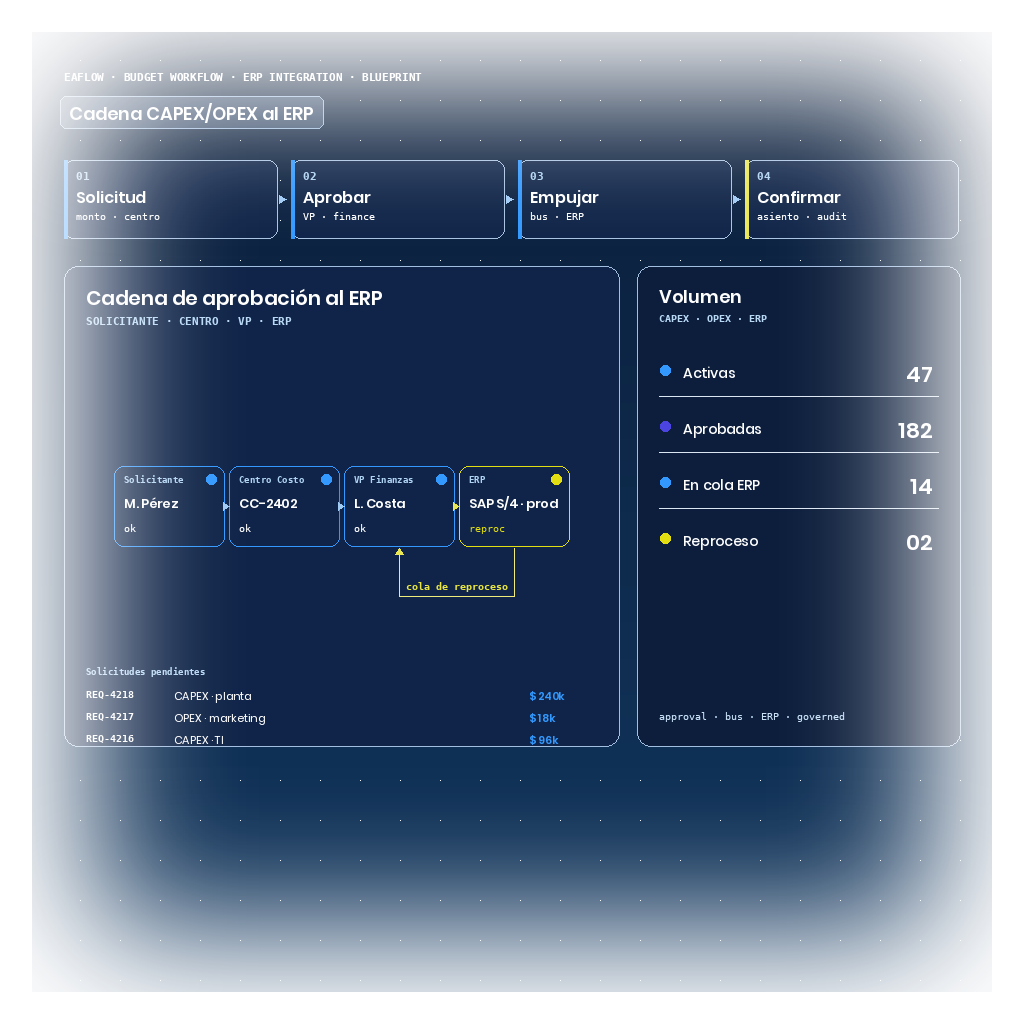
EAFlow blueprint with a CAPEX/OPEX chain into the ERP: four chained nodes (Requester, Cost Center, VP Finance, ERP) with per-node state, the ERP node in reprocessing highlighted in amber with a loop to the reprocess queue, and a side panel with CAPEX/OPEX/ERP volume.
Category
Budget Workflow — CAPEX/OPEX + ERP integration (CPG accelerator)
Users
Finance, Controlling, Workflow Operations, supply chain finance
Output
Multi-level approval chain, traceable evidence, financial ERP integration
Implementation
Industry accelerator with assisted implementation
Does not replace
Your existing corporate financial ERP (S/4, ECC); the workflow wires on top without replacement

01 · What it is

A spreadsheet and a mail thread are not an audit artifact.
A chain signed on the graph is.

In a CPG multinational with N company entities, exceptional OPEX budget extensions and CAPEX approvals require a multi-level chain by VP, Directorate, Cost Center and Operating Account, with audit-grade traceability. External anchors: +50% faster and 30% fewer errors with digital CAPEX vs mail (Cflow); the S/4 license at ≥ USD 200/user/month makes putting occasional approvers inside the ERP unsustainable at scale (top10erp.org); the ERP vendor pushes against extending the core (Precisely); many CPG organizations operate ECC and S/4 in coexistence during migration (Birchman 2026).

Budget Workflow — Extraordinary CAPEX/OPEX Approval & ERP Integration originates, approves and integrates the exceptional request into the financial ERP through the service bus. The approval chain lives on the graph (not on a spreadsheet); master data is edited with audited CRUD through Continuous Improvement; the reprocessing agent classifies integration errors and re-submits without human intervention for known repeating failures. The approval layer is ERP-agnostic between ECC and S/4.

One chain, one integration, one classified reprocessing queue.

02 · Graph context

The graph entities that anchor approval and integration.

Budget Workflow does not invent a parallel financial model. It operates on the same Operational Graph that already holds the company entities, the cost centers, the operating accounts and the approval chain by company entity — and links every exceptional request to its place in that fabric. These are the entities that participate:

  • Request · The OPEX or CAPEX case — type, company entity, amount, operating accounts, cost centers, classification
  • Company entity · The legal entity submitting the request — sets the applicable approval chain and the jurisdiction policy
  • Cost center / Account · The accounting destination where the extraordinary expense or the asset is booked
  • Approval chain · Multi-level configuration by company entity / cost center — VP / Director / OPEX Approver / CAPEX Approver / Informed
  • ERP integration bus · The bridge to the corporate financial backbone (S/4 or ECC coexistence) through authenticated services
  • Reprocessing queue · Records with integration errors — classified by type (FX rate, conversion, status) and re-submitted by an agent

An OPEX or CAPEX request gains meaning from its relationships. The graph connects each case to the company entity, the cost center, the applicable approval chain, the integration bus to the ERP and the classified reprocessing queue. The monthly closing stops being blocked by manual re-submissions that nobody chases until accounting asks.

03 · What you get

Operational capabilities of Budget Workflow — Extraordinary CAPEX/OPEX Approval & ERP Integration.

Budget Workflow runs as an industry accelerator on your Operational Graph — built on: Workflow Automation, an integration bus to the financial ERP, a classified reprocessing agent and an editable master data layer. It produces five operational capabilities — each built by relationship on the graph, not by spreadsheets manually reconciled with the ERP.

Built for CPG multinational multi-entity organizations on S/4, ECC or hybrid backbone — clean-core preserved, upgrade path preserved.

  • Form by type (OPEX / CAPEX) with master data from the graph

    Company entities, VPs, Directorates, Cost Centers, Operating Accounts, Product Categories, Logistics Centers, Asset Class, Classification — all from the graph, not from a separate spreadsheet. The form changes by type and by company entity.

  • Multi-level chain configurable by company entity / cost center

    OPEX Approver or CAPEX Approver in chain, with an optional Informed role. Every transition is signed by its author with a pending-task banner and audit trail.

  • Financial ERP integration by service

    On approval, the bus pushes the request to the ERP (S/4 or ECC) through an authenticated service. ERP-agnostic between ECC and S/4 — works with both during migration coexistence. Clean-core S/4 compatible: does not extend the core or break the upgrade path.

  • Classified reprocessing agent

    If the integration fails, the record is flagged for reprocessing; the agent scans the queue, classifies the error (FX rate, conversion field, incompatible status, annual budget exceeded by master data) and re-submits without human intervention for known repeating failures.

  • Continuous Improvement of master data with audited CRUD

    The Tier-2 admin (Continuous Improvement role) maintains the base of company entities, VPs, cost centers, accounts, asset class and approval chain with audited CRUD. Integration error patterns feed back into this layer.

04 · Who runs it

Three fronts. One monthly close.

Budget Workflow involves three fronts around every request: the originator (OPEX or CAPEX Creator) with their passive Informed role, the multi-level Approver chain, and the Continuous Improvement + Advanced layer that maintains the platform. Each front sees the same graph from a different angle — and contributes back to it.

OPEX / CAPEX Creator and Informed

Originates the request and receives visibility on the outcome.

What they see

The status of their request, the applicable approval chain, the remaining SLA time, the outcome of the ERP integration and the signable PDF of the approval once closed.

What they do

Completes the form by type (OPEX or CAPEX) with company entity, organization, centers, accounts and amount; attaches justification when required; monitors progress. The Informed role receives passive visibility without triggering transitions.

Approver in chain

Validates and signs every step of the multi-level chain.

What they see

The queue of requests pending their signature, the full context of the case (company entity, cost center, prior chain, justification), the remaining SLA and the requests that depend on their approval to advance to the ERP.

What they do

Validates that the request meets the policies of their level, approves or rejects with reason recorded and signs. At the close of the chain, the integration bus pushes the request to the ERP through the service.

Continuous Improvement and Advanced

Maintain master data and supervise the reprocessing queue.

What they see

The editable master data base (company entities, VPs, cost centers, accounts, asset class, approval chain), the dashboard of pending and failed records, the classifications of the reprocessing agent and the operational reporting of SLA and re-submissions.

What they do

Continuous Improvement maintains master data with audited CRUD; Advanced supervises the reprocessing queue, tunes agent classifications and resolves cases that require human intervention. Error patterns become improvements to the master data layer.

05 · Delivery

Assisted implementation on your existing financial backbone.

Budget Workflow is delivered through assisted implementation — an industry accelerator delivered in a scoped engagement, built on: the corporate financial ERP you already run (S/4, ECC or both in coexistence). EAFlow works alongside your Finance, Controlling and Workflow Operations team through three stages and transfers ownership at the end.

Discovery

Master data + approval chain

We map the company entities and the ECC + S/4 coexistence if it applies, the cost centers and operating accounts, the CAPEX classification by asset class and the multi-level approval chain by company entity. Scope is declared on your Operational Graph.

Connection

Integration bus + clean-core

We connect the bus to the corporate financial ERP (S/4 or ECC) through authenticated services, configure the master data editable through Continuous Improvement and deploy the classified reprocessing agent. The ERP core is not extended; clean-core preserved, upgrade path preserved.

Adoption

Training + operation

We deploy the workflow portal, train OPEX/CAPEX Creators, Approvers in chain, Informed users, Continuous Improvement and Advanced; activate the reprocessing agent for known repeating failures; transfer operational ownership. After that, your finance team runs it.

The monthly closing stops being blocked by manual re-submissions.

Extraordinary budget extensions are one of the points where the financial ERP falls short without extending the core. Book a 30-minute conversation. We will walk through how Budget Workflow runs on your Operational Graph and what assisted implementation looks like across your portfolio of company entities.

Budget Workflow — Extraordinary CAPEX/OPEX Approval & ERP Integration is an industry accelerator on the EAFlow Operational Graph, available through assisted implementation in CPG multinational multi-entity organizations. It runs alongside the corporate financial ERP backbone (S/4 or ECC coexistence) — does not replace the base budget module, is not planning or forecasting; it adds the exceptional approval layer the ERP does not flex without custom code.