EAFLOW · SHARED SERVICES ACCELERATOR

HR Shared Services — Negotiated Offboarding.
Agreed employee separations, managed as traceable case files.

EAFlow centralizes request, approvals, documents, signatures and operational handoff in a single queue for HR Shared Services. It coexists with HCM, Payroll and e-signature; it adds workflow, routing and evidence.

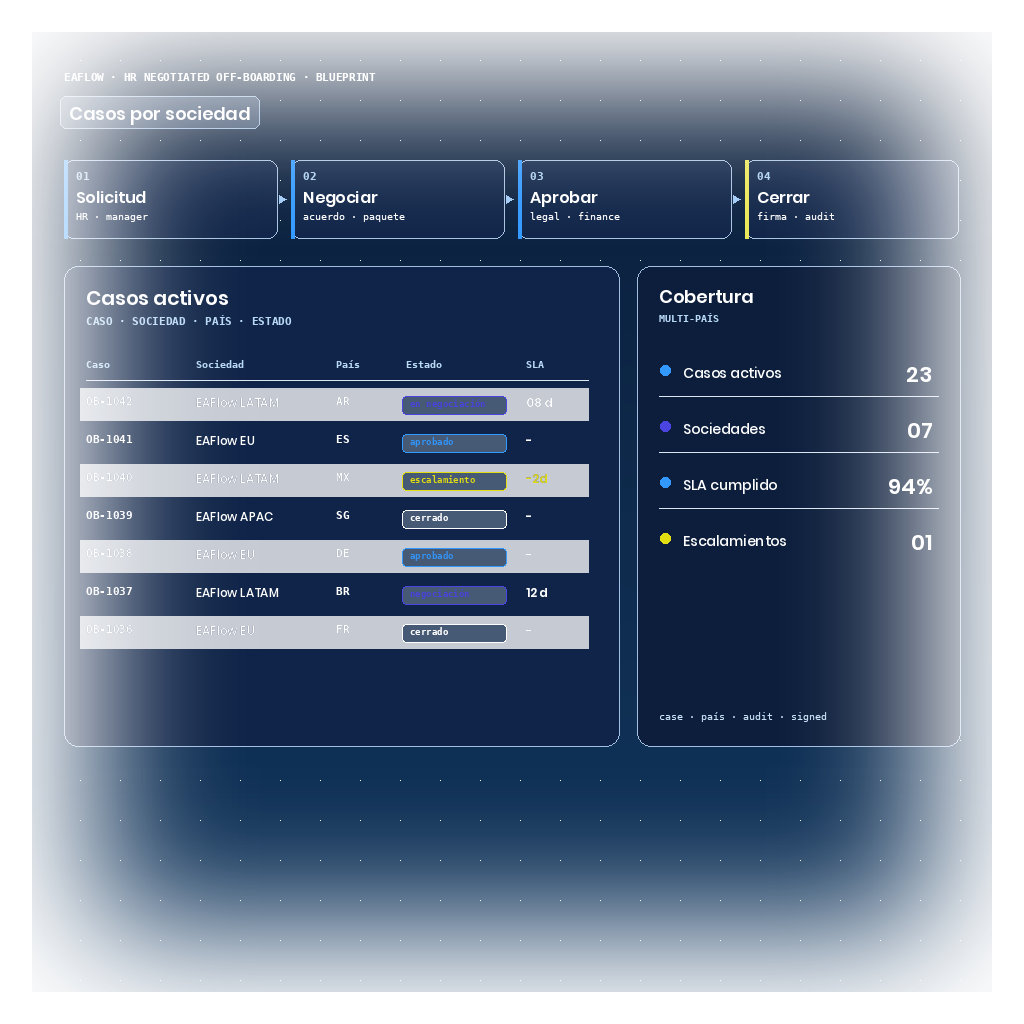
EAFlow blueprint with separation cases: a table with case, legal entity, country, owner, state (intake, in review, approved, blocked, closed) and SLA — one case in legal review highlighted in amber.
Category
HR Shared Services — Negotiated Offboarding
Use cases
Mutual separation, negotiated exit, separation agreement and local variants.
Built for
HR Shared Services, Payroll, Legal and People Operations.
Outcome
A signed, traceable case file ready for review.
System fit
Coexists with HCM/ERP, Payroll and e-signature platforms.
Does not replace
It does not replace HCM/ERP, Payroll or e-signature; it does not compute settlements — it adds workflow, routing, approvals, traceability and evidence.

01 · The problem

Email is not a case file.

An agreed employee separation can involve manager, HR, Payroll, Legal, documents, signatures, approvals and updates in core systems.

When that process lives in emails, spreadsheets or informal conversations, traceability is lost: who requested, who reviewed, which condition applied, which document was signed and when the case was closed.

EAFlow turns every negotiated separation into a governed case, with owners, states, approvals, documents and evidence.

02 · The solution

From request to a traceable case file.

HR Shared Services receives the request, validates the context, coordinates internal reviews, manages approvals, prepares documents, controls signatures and leaves the case ready for operational closure.

EAFlow connects every step in a single flow over the Operational Graph: intake, routing, approvals, document package, e-signature, HCM/ERP handoff and audit-ready evidence — with each case connected to its employee, legal entity, country, owner, policy, documents, signatures, SLA and evidence.

When that separation journey —reviews, approvals, signature and closure— is taken to a governed flow, it can grow from the same graph, with the context of country, legal entity and policy, rather than from an isolated workflow.

The result is not another inbox. It is a complete operational case file.

03 · Capabilities

Core capabilities for HR Shared Services.

  • Case intake

    Controlled intake of negotiated offboarding requests, with minimal data, employee, legal entity, country and operational reason.

  • Country & entity-aware workflow

    Flows that adapt by country, legal entity, internal policy, role, required documentation and approvers — no rigid hard-coded rules.

  • Multi-role approvals

    Coordination across manager, HR Shared Services, Payroll, Legal, Compliance and other defined owners.

  • Document package & e-signature

    Preparation, review, signature and filing of the documents associated with the case.

  • Audit-ready case file

    Comments, attachments, approvals, signatures, states and decisions stay in a traceable case file.

  • HCM/ERP handoff

    Operational closure ready for update in HCM/ERP, Payroll or document systems — without extending the core.

04 · Roles

One case, multiple Shared Services roles.

Requesting Manager

Initiates the request and provides the case context.

What they see

The status of their request, what information is missing and who the next approver is — on a single view.

What they do

Initiates the request and provides the case context for evaluation.

HR Shared Services Agent

Coordinates the flow, classifies and monitors.

What they see

The queue with cases by status, country, legal entity, owner and SLA; the case history; the associated documentation.

What they do

Coordinates the flow, classifies the case, monitors states and manages hand-offs.

Payroll / Legal Owner

Validates conditions, impacts and risks.

What they see

The cases escalated to their area, with the applicable policy, the documents and the case context.

What they do

Validates conditions, payroll impacts, documents, risks or required approvals.

Service Admin

Configures the flow and its parameters.

What they see

The configuration: categories, routing rules, owners, SLAs, templates and states.

What they do

Configures categories, routing rules, owners, SLAs, templates and flow states.

05 · Rollout

Assisted rollout over your existing HR landscape.

EAFlow is implemented over the current operating model. It does not require replacing HCM, ERP, Payroll or e-signature.

1 · Operating model discovery

Entities, countries, roles and policies

Legal entities, countries, roles, policies, approvals, documents and systems involved. Scope is declared on the Operational Graph.

2 · Workflow configuration

Rules by country, entity and separation type

Rules by country, legal entity, separation type, owner, required approval and associated documentation.

3 · Launch & handover

Queue, forms and handover

Operational queue, forms, states, reports, training and handover to the Shared Services team.

06 · Scenarios

Typical scenarios covered.

  • Mutual separation
  • Negotiated exit
  • Separation agreement
  • Mutuo acuerdo / mutuo disenso
  • Rupture conventionnelle
  • Document generation & signature
  • Payroll & HCM/ERP handoff
  • Evidence package for HR, Legal and audit

Agreed employee separations should not depend on scattered emails. EAFlow lets HR Shared Services run every case with workflow, approvals, documents, signatures, handoff and traceable evidence.

HR Shared Services — Negotiated Offboarding is a solution on the EAFlow Operational Graph for HR Shared Services. It runs alongside the HCM/ERP, Payroll and e-signature tools — it does not replace core systems or compute settlements; it adds workflow, routing, approvals, traceability and evidence.