EAFLOW · SOLUTIONS · CPG INDUSTRY ACCELERATOR

Service Desk — Multi-actor Supplier & Internal Request Management.
One queue, four roles,
a graph that routes each case to the right focal point.

Industry accelerator for Shared Service Centers that handle dense Tier-1/2/3 supplier chains and internal areas in CPG multinationals. Runs on Operational Graph + Workflow Automation. External supplier self-registration, configurable form, graph-assisted routing by company entity, category and focal point, ticket state machine and operational reporting with aging and SLA. Layer alongside the ERP; does not replace SRM or Source-to-Pay. Assisted implementation. Reusable multi-actor pattern — leveraged by Service Operations Governance for external-resolver coordination.

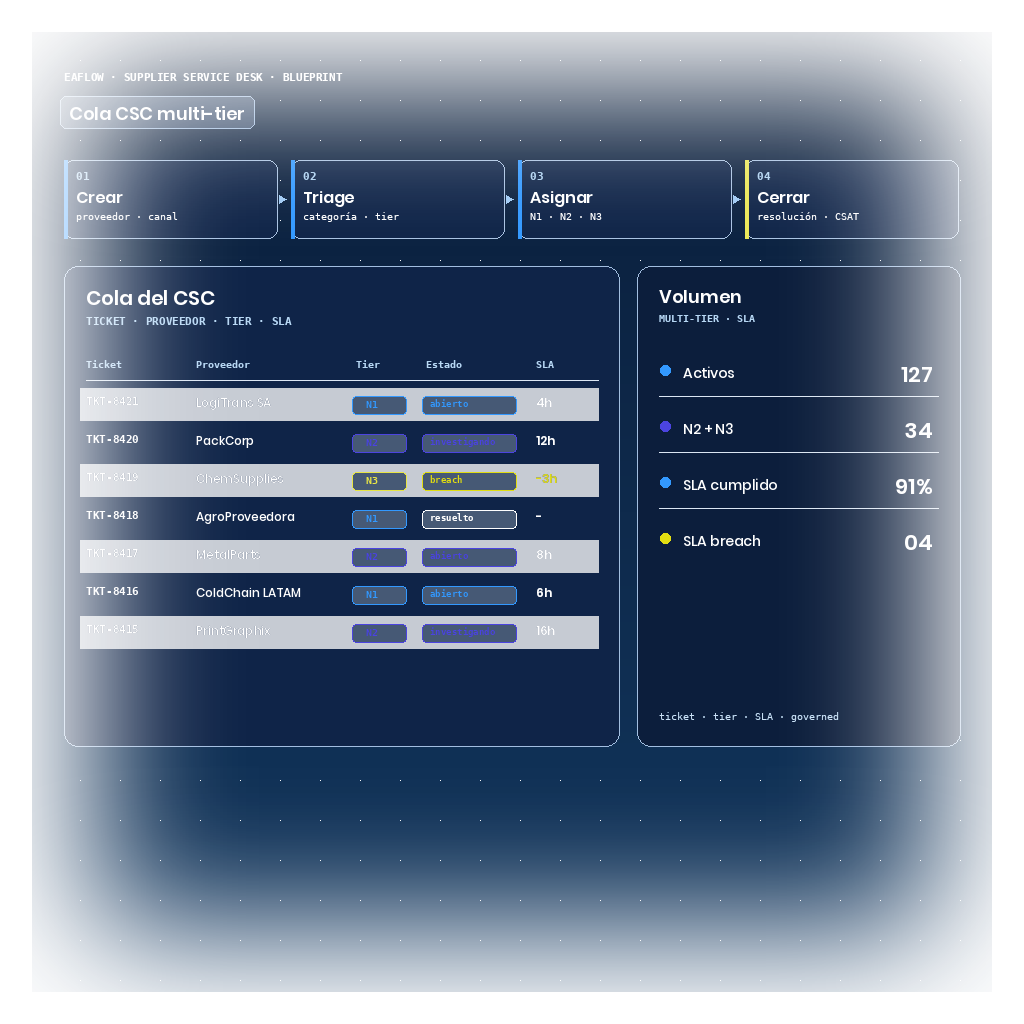
EAFlow blueprint with a multi-tier CSC queue: a table with ticket, supplier, tier (N1/N2/N3), state and SLA — one ticket with SLA breach highlighted in amber — and a side panel with CSC volume and SLA.
Category
Reusable multi-actor pattern — CPG accelerator for CSC with external suppliers
Users
Procurement Ops, Workflow Operations, supplier relationship
Output
Multi-actor queue with SLA, attention tiers, documented evidence
Implementation
Industry accelerator with assisted implementation
Does not replace
Your existing CSC and supplier base; the graph routes each case to the right focal point

01 · What it is

A saturated mailbox is not a service desk.
A graph that routes is.

In a CPG multinational, the dense Tier-1/2/3 supplier chain (raw materials, packaging, transport, MRO, services) and the internal areas are handled by a Shared Service Center. Without dedicated ticketing, the CSC lives in a saturated mailbox where supplier onboardings, claims, queries, company-entity extensions and compliance docs all blur together. And the 2026 outlook shows that multi-country compliance complexity plus supplier data is accelerating (PFAS, ESG, fee shifts): asking the same supplier for the same data twice kills the relationship.

Service Desk — Multi-actor Supplier & Internal Request Management runs as a layer alongside the ERP. It receives, classifies, routes and resolves cases across External Supplier, Internal User, Tier-1 Agent, Tier-2/3 Focal Point and Advanced User. It reuses the same identity + audit + graph layer as the rest of the CPG accelerators. Does not replace SRM or Source-to-Pay in the ERP — it runs alongside.

One queue, four roles, a graph that routes.

02 · Graph context

The graph entities that anchor multi-actor service.

Service Desk — Multi-actor Supplier & Internal Request Management does not invent a parallel ticket model. It operates on the same Operational Graph that already holds company entities, categories, focal points by area and a cleaned-up supplier base — and links every ticket to its place in that fabric. These are the entities that participate:

  • Originator · External supplier or internal user — linked to their company entity, their category and their history of prior tickets
  • Ticket · The case itself — type, company entity, status, transition history, attachments and recorded resolution
  • Type / Category · Onboarding, company-entity extension, account unlock, compliance collection — defines form, SLA and routing
  • Company entity · The legal entity involved — sets the applicable focal point and the jurisdiction policy
  • CSC role · Tier-1 Agent / Tier-2-3 Focal Point / Advanced User — who handles, escalates or administers each case
  • Area focal point · The Tier-2/Tier-3 owner who resolves on escalation — Procurement, Quality, Treasury, Logistics

A ticket gains meaning from its relationships. The graph connects each case to the company entity, the category, the correct focal point and the prior history of the supplier or the area. Ghost-ticket cleanup becomes an auditable procedure; supplier-data freshness is measured rather than guessed.

03 · What you get

Operational capabilities of Service Desk — Multi-actor Supplier & Internal Request Management.

Service Desk runs as an industry accelerator on the Operational Graph — built on: Workflow Automation, federated identity with external self-registration, notification engine and operational reporting. It produces five operational capabilities — each built by traversal on the graph, not by mail threads and local spreadsheets.

In Service Operations, this pattern helps to operate with vendors and external resolver groups when resolution happens outside the central platform, keeping central ticket, states, comments, evidence, times and SLA/OLA compliance.

One central ticket. Many resolvers. A single traceability.

Built for the corporate CSC of a CPG multinational — applies where the Tier-1/2/3 supplier chain and the internal areas share a single backlog.

  • External supplier self-registration

    The supplier self-registers from the portal, receives credentials by mail and gets linked to their company entity on the graph. No mail to the CSC to start the relationship, no local Excel spreadsheet.

  • Multi-role queue with state machine

    Every ticket runs DRAFT → ASSIGNED → RESOLUTION → CLOSED. Supplier, Internal User, Tier-1 Agent, Tier-2/3 Focal Point and Advanced User all see the same queue from their role; every transition is signed by its author.

  • Graph-assisted routing

    The graph connects company entity, category and applicable focal point; it suggests type and recipient to the originator. No hard-coded country rules; no mail threads lost between areas.

  • Controlled procedure for mass cleanup

    Ghost tickets (open in system, resolved by mail) are resolved through a controlled procedure: diagnostic SELECT first, audited mass update, post-verification. The Advanced User stops closing tickets one by one in the UI.

  • Operational reporting for aging and SLA

    Dashboard of queues, aging by category, on-SLA close rate, supplier-data freshness (do not ask for the same data twice). CSC operations stop living inside a saturated mailbox.

04 · Who runs it

Three fronts. One case graph.

Service Desk — Multi-actor Supplier & Internal Request Management involves three fronts around every case: the external or internal originator who opens the ticket, the Tier-1 agent who classifies and resolves on first line, and the Tier-2/3 focal point or Advanced user who handles escalations and administers the platform. Each front sees the same graph from a different angle — and contributes back to it.

External supplier and internal user

Originates the ticket; receives the resolution.

What they see

The status of their tickets, what information is missing, which documents are still pending and which resolution has been recorded — from the portal, without requiring access to internal systems.

What they do

Self-registers (if external supplier), completes the ticket form by type, attaches compliance documentation when required and monitors progress until closure.

Tier-1 Agent — Service Desk

Receives, classifies, resolves or escalates the case.

What they see

The full CSC queue with tickets by aging, by category, by company entity and by focal point; the complete history of each case; the response templates and the applicable SLAs.

What they do

Classifies the incoming ticket, resolves it if it falls within their scope or routes it to the corresponding Tier-2/3 Focal Point; records the resolution, the relevant attachments and the outcome.

Tier-2/3 Focal Point and Advanced User

Resolves escalations; administers the platform.

What they see

The tickets escalated to their area (Procurement / Quality / Treasury / Logistics) with the full graph context: company entity, category, prior history with the supplier, attached documentation and remaining SLA.

What they do

Resolves the escalation and returns the result to the ticket; the Advanced User maintains the platform with controlled procedures (audited mass closures, ghost-ticket cleanup, type and SLA maintenance).

05 · Delivery

Assisted implementation on your existing CSC.

Service Desk — Multi-actor Supplier & Internal Request Management is delivered through assisted implementation — an industry accelerator delivered in a scoped engagement, built on: the existing CSC and supplier base. EAFlow works alongside the customer's Procurement Ops and Workflow Operations team through three stages and transfers ownership at the end.

Discovery

Type catalog + CSC roles

We map the ticket categories the CSC needs to handle (onboarding, company-entity extension, account unlock, compliance docs, etc.), the CSC roles involved, the focal points by area and the applicable SLAs by type. Scope is declared on the Operational Graph.

Connection

Identity + self-registration + notification

We connect federated identity for internal users, the self-registration engine for external suppliers, the email notification engine and the operational graph with company entities, categories and focal points. The supplier base is cleaned up or imported during initial onboarding.

Adoption

Training + initial cleanup

We deploy the multi-role portal, train Tier-1 agents, Tier-2/3 focal points and Advanced users; run the initial ghost-ticket cleanup using the controlled procedure; transfer operational ownership. After that, the customer's CSC runs it.

Supplier-data freshness is measured rather than guessed.

The relationship with a dense supplier chain is built one ticket at a time. Book a 30-minute conversation. We will walk through how Service Desk — Multi-actor Supplier & Internal Request Management runs on the Operational Graph and what assisted implementation looks like for the customer's CSC.

Service Desk — Multi-actor Supplier & Internal Request Management is an industry accelerator on the EAFlow Operational Graph, available through assisted implementation in CPG multinational multi-entity organizations. It runs alongside the corporate ERP/SRM — does not replace Source-to-Pay or the SRM/MDG modules; it adds the multi-role service layer the ERP does not provide.