

Step 01
Assisted migration
Import, review and conversion of existing models to BPMN 2.0. EPC/VAC, convention-free flows, legacy models — everything enters the discovery pipeline with human validation.
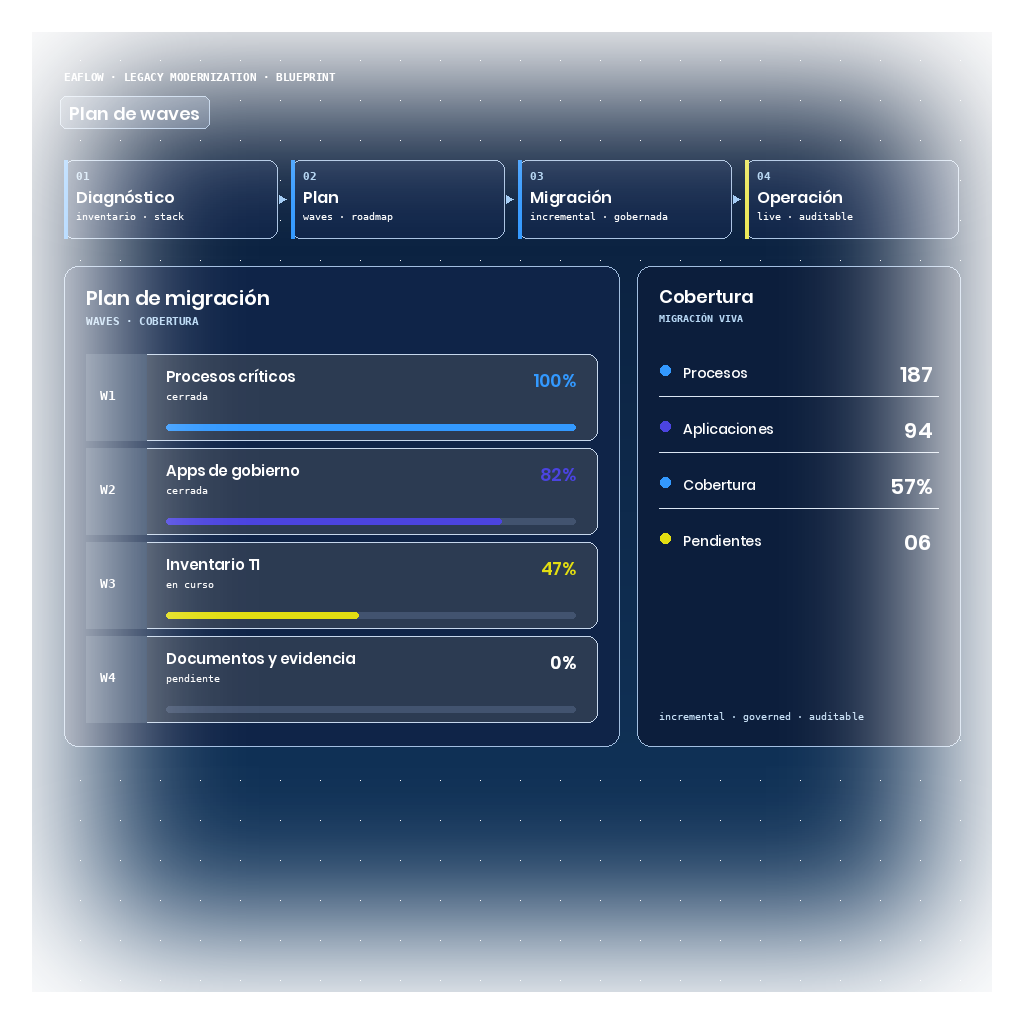
Many organizations have years of knowledge trapped in process, architecture or control repositories that are difficult to maintain. Built on Operational Graph. Migrate existing models, normalize them, govern them and connect them to real operations. Not about moving diagrams — about turning them into a living foundation for deciding, auditing, improving and operating. Progressive modernization, no big-bang.
Step 01
Import, review and conversion of existing models to BPMN 2.0. EPC/VAC, convention-free flows, legacy models — everything enters the discovery pipeline with human validation.
Step 02
Conventions, detail levels, owners, roles, events, activities, controls and metadata. Value chain reviewed. Extended or inconsistent processes refined.
Step 03
Versioning, approval, traceability, portal, reports and evidence. Parametrizable approval workflow. Domain-controlled publication.
Step 04
Processes connected to applications, data, risks, controls, documents, tickets and continuity. Modernization does not end at the diagram; it connects to the live operation of the Operational Graph. When a modernized process lives in that governed graph, it can also orchestrate its execution from the same context: the flow is born from the graph, not from an isolated model.
Step 05
Initial coexistence with legacy tools. Gradual cutover. Reduction of technology dependency without big-bang. Modernization is a journey, not an event.
Modernization connects to the cross-industry solutions on the Operational Graph:
Modernize it, govern it and connect it to real operations.
Plan a progressive exit →